Introduction
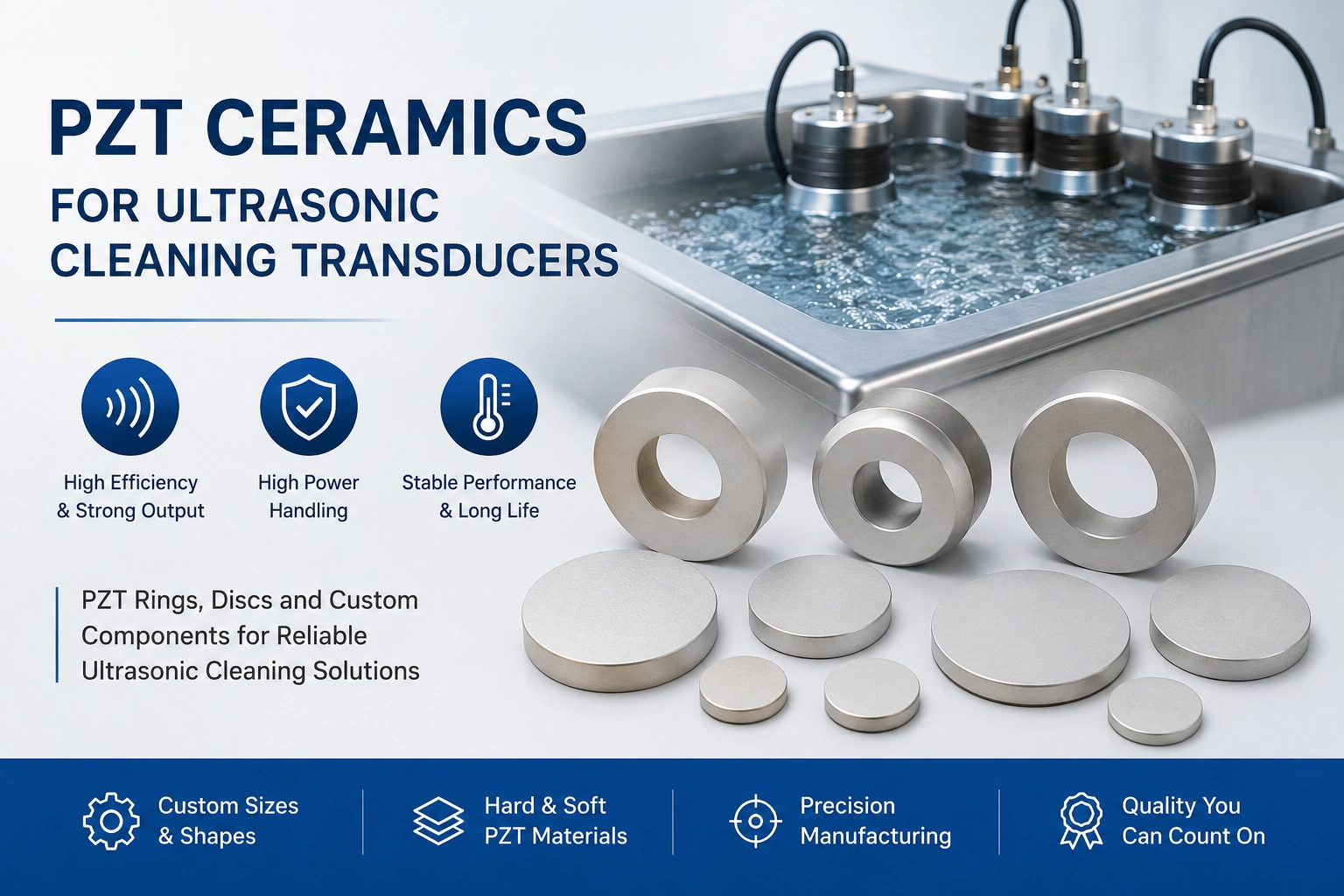
An ultrasonic cleaning transducer converts electrical energy into high-frequency mechanical vibration for cleaning tanks and liquid cleaning systems. PZT ceramics are widely used in ultrasonic cleaning transducers because they provide strong electromechanical conversion, stable resonance and practical manufacturability in different shapes. In an ultrasonic cleaning system, this vibration helps generate cavitation activity for removing contamination from surfaces, holes, grooves and complex parts.
Choosing the right ultrasonic cleaning transducer material is not only about selecting a ceramic with high sensitivity. Cleaning transducers often operate under high drive levels, repeated vibration cycles and thermal-mechanical stress. Material loss, resonant frequency stability, ceramic geometry, bonding condition and mechanical assembly all affect final performance.
This guide explains how PZT ceramics are used in ultrasonic cleaning transducers and what engineers or buyers should consider when specifying custom piezoelectric ceramic components.
Why PZT Ceramics Are Used in Ultrasonic Cleaning Transducers
PZT ceramics generate mechanical deformation when an electric field is applied. This property allows an ultrasonic cleaning transducer to convert an electrical signal from the ultrasonic generator into mechanical vibration.
In ultrasonic cleaning systems, the transducer must deliver stable vibration into the cleaning tank. The ceramic element is therefore expected to provide efficient electromechanical conversion, stable resonant frequency, suitable power handling, controlled heat generation and reliable operation under repeated excitation.
PZT ceramics are especially useful because they can be manufactured into discs, rings, plates, tubes and custom geometries. This allows the ceramic element to match different ultrasonic cleaning transducer designs, including bonded disc-type transducers and bolt-clamped transducer stacks.
Key Requirements for PZT Ceramics in Ultrasonic Cleaning
High Mechanical Quality Factor Qm
For an ultrasonic cleaning transducer, mechanical quality factor, usually written as Qm, is one of the most important material parameters. A higher Qm generally indicates lower mechanical loss under resonance. This matters because ultrasonic cleaning transducers often operate continuously or semi-continuously at a fixed frequency.
In high-power ultrasonic cleaning, the ceramic is not only generating a signal. It is working as part of a resonant power system. If the ceramic material has excessive internal loss, more energy becomes heat instead of useful vibration.
For this reason, hard PZT ceramics are often preferred for high-power ultrasonic applications. They usually provide higher Qm, lower loss and better stability under stronger drive conditions than soft PZT materials.
For a broader comparison of material types, see our PZT material selection guide.
Low Dielectric Loss and Heat Control
Heat generation is a major design concern in ultrasonic cleaning transducers. The ceramic element is driven electrically, but not all input energy becomes mechanical vibration. Dielectric loss, mechanical loss and assembly loss can all contribute to temperature rise.
Excessive heat can lead to frequency drift, reduced output efficiency, unstable cleaning performance, faster aging of the ceramic element, bonding reliability problems and risk of depolarization under severe conditions.
For this reason, low-loss PZT ceramics are usually preferred for high-power ultrasonic cleaning. A material with lower dielectric loss and higher stability is generally more suitable than a material selected only for high piezoelectric charge constant.
Stable Resonant Frequency
Ultrasonic cleaning transducers are designed around a target resonant frequency. If the ceramic element or assembly shifts too far from the intended resonance, the ultrasonic generator may not drive the transducer efficiently.
Resonant frequency can be affected by PZT ceramic material grade, ceramic dimensions, electrode design, ceramic thickness and diameter, bonding layer, metal mass structure, bolt preload, operating temperature and long-term stress.
For custom PZT ceramics, dimensional control is therefore critical. Even small changes in ceramic thickness, diameter or ring geometry can influence electrical capacitance, mechanical resonance and final transducer behavior.
Hard PZT vs Soft PZT for Ultrasonic Cleaning
Hard PZT and soft PZT are not simply “better” or “worse.” They are suited to different application conditions. Technical references on hard and soft piezoelectric ceramics commonly distinguish soft ceramics by larger displacement and wider signal bandwidth, while also noting greater hysteresis and higher risk of depolarization or deterioration under demanding conditions.
Soft PZT materials are often selected when high sensitivity, strong signal response or large piezoelectric coefficients are more important. They are commonly used in sensing, receiving and lower-power actuator applications.
Hard PZT materials are generally preferred in high-power ultrasonic applications because they offer better stability under strong drive, lower losses and higher mechanical quality factor. For an ultrasonic cleaning transducer, the typical engineering priority is not maximum d33. The priority is stable output under repeated high-power operation.
That is why hard PZT ceramics are usually a more suitable choice for cleaning transducer stacks, especially where continuous duty cycle, heat control and frequency stability are important.
However, final material selection still depends on the design target. A small ultrasonic cleaning device, a high-power industrial cleaning tank and a specialized precision cleaning system may require different ceramic grades, dimensions and assembly structures.
Common PZT Shapes Used in Ultrasonic Cleaning Transducers
PZT Rings
PZT ceramic rings are commonly used in bolt-clamped ultrasonic transducers. The central hole allows a preload bolt to pass through the ceramic stack. This structure is often used in high-power transducers because the ceramic rings are compressed between metal masses.
A bolt-clamped design helps maintain mechanical contact, improves energy transfer and reduces tensile stress on the ceramic during vibration. For ultrasonic cleaning applications, PZT rings are especially relevant when the design requires high power output, stable resonance, stack assembly, preload control and long-duty operation.
Key ring parameters include outer diameter, inner diameter, thickness, electrode surface, polarization direction and material grade.
For a broader shape comparison, see our guide to PZT discs, rings, plates and tubes geometry selection.
PZT Discs
PZT ceramic discs are also used in ultrasonic cleaning transducers, especially in bonded designs where a ceramic disc or ceramic-metal combination is attached to a cleaning tank surface.
PZT discs may be suitable for certain compact cleaning designs or specific vibration structures. Compared with rings, discs are simpler in geometry, but they do not provide the same central-bolt structure used in bolt-clamped stacks.
Important disc parameters include diameter, thickness, resonant frequency, electrode material, polarization direction, bonding surface, capacitance range and material grade.
For high-power industrial cleaning systems, the final choice between PZT discs and PZT rings depends on the ultrasonic cleaning transducer architecture, not only the ceramic shape.
Design Factors That Affect Cleaning Transducer Performance
Operating Frequency
Ultrasonic cleaning systems are designed for specific frequency ranges depending on cleaning intensity and application requirements. Lower frequencies are often associated with stronger cavitation effects, while higher frequencies may be selected for finer cleaning requirements.
The PZT ceramic must be designed around the target resonant frequency. Frequency is influenced by both the ceramic element and the complete transducer assembly. A ceramic ring or disc cannot be evaluated only as an isolated part; it must be considered together with the metal mass, bolt preload, bonding layer and generator matching conditions.
Power Level and Duty Cycle
A short-duty cleaning transducer and a continuous industrial ultrasonic cleaning transducer do not place the same stress on PZT ceramics.
For higher power or longer duty cycles, buyers should pay closer attention to hard PZT material selection, Qm, dielectric loss, heat dissipation, aging behavior, electrode reliability, assembly stress and bonding quality.
A ceramic material that works well in a low-power device may not be suitable for a high-power industrial ultrasonic cleaning tank.
Bonding, Preload and Mechanical Assembly
Even when the correct PZT ceramic material is selected, poor mechanical assembly can reduce performance.
Common problems include uneven bonding thickness, insufficient preload, excessive preload, poor electrode contact, ceramic edge chipping, misalignment in stack assembly and stress concentration near the inner hole of a ring.
For bolt-clamped ultrasonic transducers, the ceramic ring stack must be assembled carefully so that the ceramic works under controlled compression. For bonded disc-type cleaning transducers, adhesive selection and bonding consistency strongly affect energy transfer and long-term reliability.
How to Specify PZT Ceramics for an Ultrasonic Cleaning Project
When requesting custom PZT ceramics for an ultrasonic cleaning transducer project, buyers should provide more than a product name. The more complete the specification, the easier it is to evaluate material, geometry and manufacturing feasibility.
A useful specification should include the following information:
- Target application: industrial ultrasonic cleaning tank, precision cleaning system or compact ultrasonic cleaner.
- Target frequency: operating frequency or expected resonance range.
- Power level and duty cycle: intermittent operation, continuous operation or high-power industrial use.
- Ceramic shape: ring, disc, plate, tube or custom geometry.
- Dimensions: for PZT rings, provide outer diameter, inner diameter and thickness; for discs, provide diameter and thickness.
- Material requirement: hard PZT, soft PZT or required performance properties if known.
- Electrode type: silver, nickel, copper or other electrode requirements.
- Polarization direction: confirm the required polarization direction for the design.
- Tolerance requirement: dimensional tolerance, flatness, parallelism or surface finish requirements.
- Quantity and project stage: prototype, pilot batch or mass production.
- Operating environment: temperature, liquid exposure, housing structure and expected working conditions.
This information helps the supplier recommend suitable PZT ceramics and reduce unnecessary trial-and-error during transducer development.
For custom manufacturing options, see our page on custom PZT ceramic components.
Common Selection Mistakes
Selecting Soft PZT Only Because of High d33
A high d33 value can look attractive on a datasheet, but ultrasonic cleaning is usually a high-power resonant application. A material with lower loss and higher stability may perform better than a material with higher small-signal sensitivity.
Ignoring Heat Generation
Heat is one of the most common reasons for unstable ultrasonic cleaning transducer performance. Material loss, poor bonding, excessive drive and unsuitable mechanical assembly can all increase temperature rise.
Treating the Ceramic as the Full Transducer
A PZT ceramic ring or disc is only one part of the transducer system. The final performance depends on ceramic material, metal structure, preload, bonding, generator matching and installation conditions.
Using Ring Dimensions Without Considering Assembly
For bolt-clamped transducers, the inner hole, outer diameter and thickness must match the mechanical stack. An unsuitable ring size may create stress concentration, poor preload distribution or incorrect resonance.
Overlooking Manufacturing Consistency
For batch production, consistency matters as much as a single sample’s performance. Ceramic composition, sintering, machining, electrode and polarization all affect final electrical and mechanical parameters.
Custom PZT Ceramic Support from Hurricane PZT
Hurricane PZT manufactures custom PZT ceramic components for ultrasonic cleaning transducers, including PZT rings, PZT discs and other piezoelectric ceramic geometries. Components can be customized according to target frequency, material requirement, dimensions, electrode design, polarization direction and assembly conditions.
For ultrasonic cleaning transducer projects, customers can provide the required operating frequency, power level, ring or disc dimensions, material preference, tolerance requirements and expected working environment. Based on these details, Hurricane PZT can support prototype development, sample verification and batch production for ultrasonic cleaning applications.
To discuss a custom project, provide your target frequency, ceramic geometry, dimensions, quantity and application requirements.