Selecting the right piezoelectric material is one of the most important steps in ultrasonic product design. In practice, material choice affects sensitivity, displacement, impedance behavior, power handling, temperature stability, and long-term reliability. Even when two devices have similar dimensions and resonant frequencies, their actual performance can differ significantly if they use different piezoelectric materials.
At ChinaUltrasound, we manufacture a wide range of piezoelectric ceramic components for ultrasonic, medical, and industrial applications. This is why material selection should never be treated as an isolated decision. In real design work, the ceramic grade, vibration mode, geometry, bonding, and operating condition all contribute to final device performance.
Soft vs Hard Piezoelectric Materials
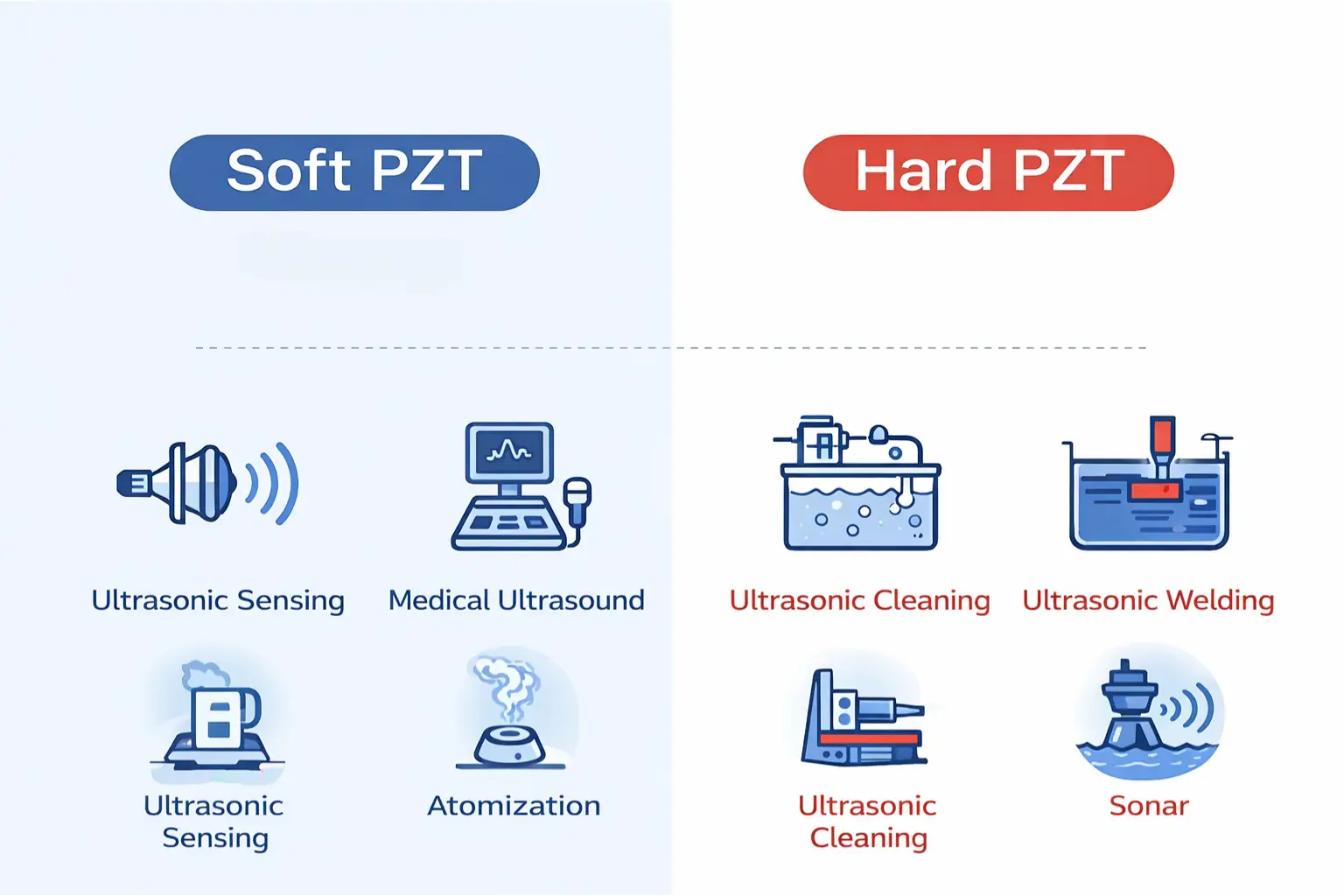
Piezoelectric ceramics are commonly grouped into soft PZT and hard PZT. In general, soft and hard piezoelectric materials differ in sensitivity, dielectric loss, mechanical quality factor, and resistance to high-power drive. Soft PZT is usually selected when higher sensitivity, stronger electromechanical response, or larger displacement at relatively low drive is needed. Hard PZT is more commonly selected for continuous or high-power ultrasonic operation, where lower internal loss, lower heating, and better stability under strong excitation are more important.
Because of these differences, there is no single “best” piezoelectric material for every ultrasonic application. The right choice depends on what matters most in the final design: signal response, thermal margin, durability, power density, or structural compatibility.
Common Piezoelectric Material Grades
Many engineers and buyers are familiar with material names such as PZT-4, PZT-5A, PZT-5H, and PZT-5J. In broad industry use, PZT-4 is usually associated with hard-material, high-power ultrasonic applications, while PZT-5 family materials are more often associated with higher sensitivity and softer behavior. These names are useful as a starting point, but they should not be treated as perfectly interchangeable across suppliers.
The safer approach is to compare the actual material properties behind the name. Parameters such as piezoelectric constants, coupling factor, dielectric loss, mechanical Q, and temperature capability matter more than the grade code alone.
How to Choose Piezoelectric Materials by Application
Ultrasonic Sensing and Receiving
For sensing and receiving applications, a softer material direction is often the best place to start because these designs usually prioritize sensitivity and signal response over continuous high-power endurance. A compact piezoelectric ceramic disc can be a practical option when stable vibration response and compact size are required.
Medical and Precision Ultrasonic Devices
In medical and precision ultrasonic designs, higher electromechanical response can improve both transmitting and receiving performance. In these cases, material selection should be considered together with matching layers, backing, acoustic structure, and drive condition rather than as a standalone material choice.
Atomization and Ring-Based Structures
For atomization and compact ring-based assemblies, geometry is often just as important as material type. A piezoelectric ceramic ring is commonly used where ring structure and vibration efficiency need to be balanced in a compact design.
High-Power Ultrasonic Cleaning and Welding
For ultrasonic cleaning, welding, and other high-power resonant systems, hard piezoelectric materials are usually preferred because they can operate with lower internal loss and better stability under sustained drive. A PZT-4 piezoelectric ring is a useful reference when evaluating hard-material solutions for bolt-clamped or power-focused ultrasonic assemblies.
Key Parameters to Review Before Material Selection
Before finalizing a material, engineers should review the parameters that most directly affect real-world performance. Piezoelectric coefficients such as d33 and d31 indicate electromechanical response. Coupling factor affects energy conversion efficiency. Mechanical quality factor is especially important in resonant high-power systems. Dielectric loss influences self-heating. Temperature capability and resistance to depolarization become critical when the device operates at elevated temperature or under strong electric field.
These parameters should always be evaluated together. A material with very high sensitivity is not automatically the best choice if the application also demands thermal stability, continuous drive, or long service life.
PZT-5A vs PZT-5H
PZT-5A and PZT-5H are both widely used soft-material directions, but they are not identical. Published PZT-5A, PZT-5J, and PZT-5H material data shows meaningful differences in dielectric constant, Curie temperature, and other performance-related properties. In simplified terms, PZT-5H is often chosen when stronger response is needed, while PZT-5A is often considered when operating margin and temperature stability matter more.
Important Design Considerations Beyond Material
Material selection alone does not determine final device performance. Geometry, vibration mode, wall thickness, adhesive layer, preload, backing, and housing structure can all change the final acoustic and electrical behavior. This is why experienced engineers evaluate the complete acoustic stack rather than selecting only by material code.
For custom projects, the most reliable approach is to evaluate material, structure, frequency, and drive condition together. A well-matched design will usually perform better than a design that simply uses the most aggressive material grade on paper.
Conclusion
Choosing the right piezoelectric material means balancing sensitivity, power handling, dielectric loss, temperature stability, and structural fit. In general, soft PZT is better suited for sensing, receiving, and response-focused designs, while hard PZT is better suited for ultrasonic cleaning, welding, and other high-power systems. For dependable product development, material selection should always be verified in the actual assembly and operating condition.