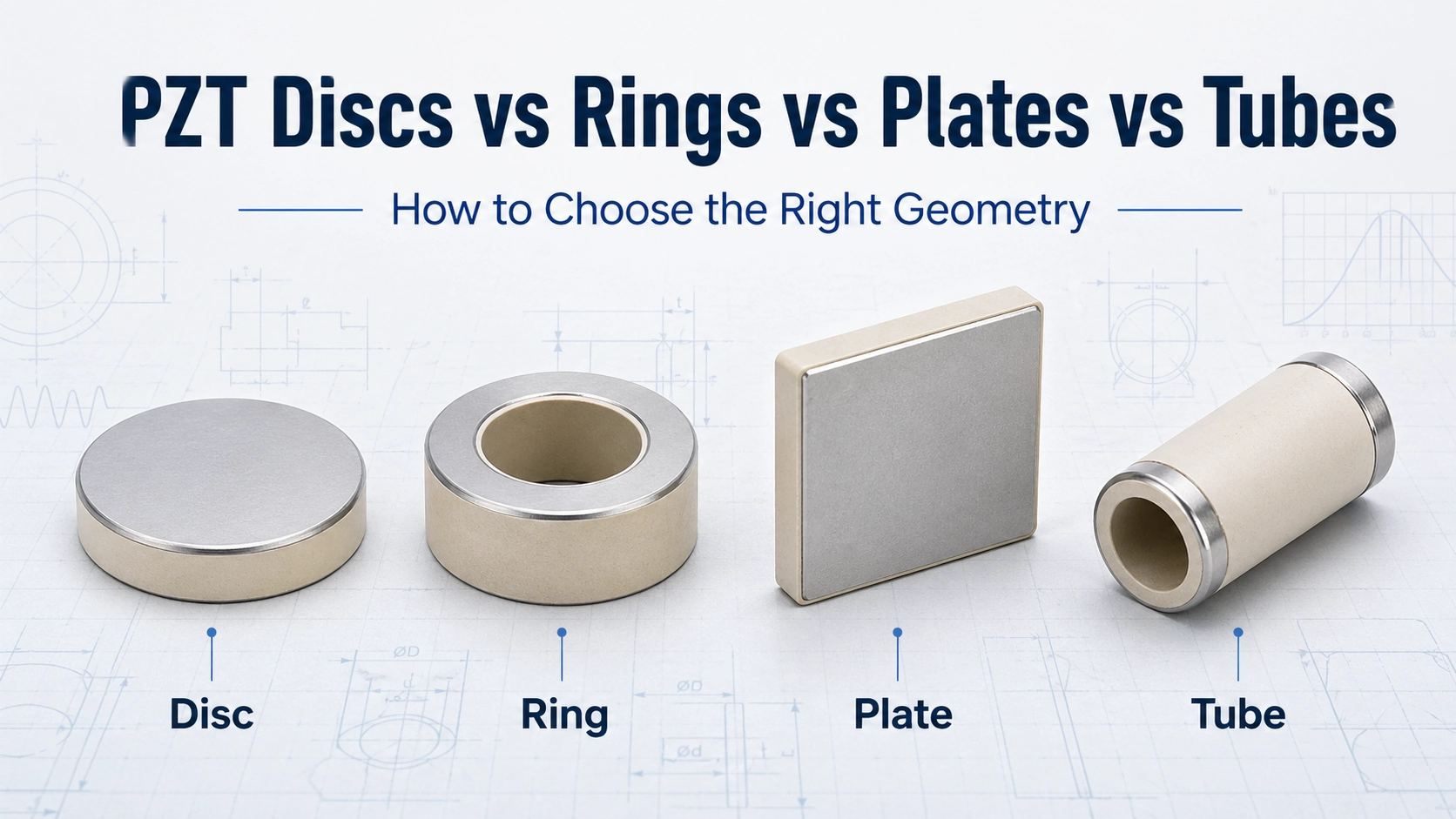
PZT discs vs rings vs plates vs tubes is a practical geometry-selection question in piezoelectric ceramic design. When engineers or buyers compare PZT ceramic parts, the discussion often starts with material grade. In many real projects, however, the first decision that shapes the design is geometry.
Why geometry matters in PZT ceramic selection
Geometry is not only a mechanical drawing issue. It directly affects how the ceramic deforms, how it couples with the surrounding structure, and how easy it is to manufacture consistently. In practical projects, geometry selection influences:
- available vibration mode
- resonant frequency range
- electrode layout
- polarization direction
- thickness-to-diameter or length-to-width ratio
- machining complexity
- crack risk during processing
- assembly compatibility with metal or polymer structures
This is why geometry should be decided together with material selection, not after it. If your team is still comparing PZT ceramic products, geometry is often the first filter that narrows the workable options.
What makes PZT discs the most common starting point
PZT discs are usually the simplest and most widely used bulk geometry. They are common because they are relatively straightforward to press, sinter, electrode, polarize, and machine. From a manufacturing point of view, discs are often the easiest shape to control consistently.
Typical advantages of PZT discs
- simple geometry and relatively stable production
- good suitability for thickness-mode and radial-mode designs
- easier dimensional control than more complex hollow parts
- wide applicability in standard ultrasonic structures
Typical engineering uses of PZT discs
- basic ultrasonic transducer structures
- sensing elements
- actuation elements
- bonded composite assemblies
When a disc is usually a good choice
A disc is often the right starting point when the project needs a compact round structure, simple mounting, and relatively straightforward frequency control. It is also a practical first option when the design does not require a central opening.
When PZT rings are preferred over discs
PZT rings are often selected when the structure needs a central hole or when the ceramic must fit around a bolt, rod, tube, or other internal mechanical path. Rings are widely used in power ultrasonic stacks and assemblies where clamping or central alignment matters.
Typical advantages of PZT rings
- central hole allows mechanical fastening or internal routing
- well suited to stacked transducer structures
- useful where preload or bolt-clamped assembly is required
- can support compact annular designs
Typical engineering uses of PZT rings
- bolt-clamped ultrasonic transducers
- power ultrasonic stacks
- annular sensing or actuation structures
- assemblies with internal shafts or flow paths
What to watch when selecting rings
Rings are more sensitive than discs to inner-diameter tolerance, wall thickness uniformity, and machining damage around the hole. If the wall becomes too thin or the dimensional ratio is poorly chosen, production yield and electrical consistency may become more difficult to control. This is one reason why PZT discs and rings should not be treated as interchangeable shapes even when the outer diameter is similar.
Where PZT plates make more sense
PZT plates are generally selected when the design is not naturally axisymmetric. Compared with discs and rings, plates fit better into rectangular, square, or laminated structures, especially when the surrounding mechanical design is also based on flat geometry.
Typical advantages of PZT plates
- better fit for flat structures and rectangular assemblies
- useful in bending, patch-type, and laminated designs
- more convenient when the host structure is not round
- easier surface bonding in some actuator and sensor layouts
Typical engineering uses of PZT plates
- surface-bonded actuators
- patch sensors
- bending structures
- flat ultrasonic or vibration-control assemblies
Selection considerations for plates
Plates are often more sensitive to edge quality, flatness, and stress concentration near corners than simple discs. In thin plates, warpage and handling damage can also become more important during manufacturing and assembly.
What PZT tubes are usually chosen for
PZT tubes are used when the project needs a cylindrical structure rather than a solid or flat one. Tubes are common in applications where radial symmetry, internal volume, or circumferential actuation is important.
Typical advantages of PZT tubes
- hollow cylindrical geometry for radial or circumferential functions
- useful when an internal channel is part of the design
- good fit for some focusing, dispensing, or fluid-related structures
- more suitable than discs or plates for certain 360-degree actuation concepts
Typical engineering uses of PZT tubes
- cylindrical actuators
- atomization-related structures
- special ultrasonic assemblies with internal passage
- custom radial deformation designs
What to watch when selecting tubes
Tubes are usually more challenging to manufacture than discs or plates. Wall thickness, concentricity, roundness, and crack sensitivity all matter. As the structure becomes thinner or longer, consistency control becomes more difficult. If the design is already moving beyond standard geometry, it may be worth reviewing custom PZT parts instead of forcing a standard tube shape into the project.
How geometry affects vibration mode selection
For readers who want a concise reference on piezoelectric terminology and material constants, a basic overview from the Encyclopaedia Britannica definition of piezoelectricity can be useful as background reading. In many projects, shape selection is really vibration-mode selection in disguise. Geometry influences which deformation mode can be used efficiently and which one becomes difficult to control.
Discs
Discs are commonly used for thickness mode and radial mode, depending on diameter-to-thickness ratio and electrode arrangement.
Rings
Rings are often selected when annular geometry must work with axial clamping or when the central opening is structurally necessary.
Plates
Plates are more natural in flat structures and can be suitable for extension, thickness-related, or bending-related designs, depending on polarization and mounting method.
Tubes
Tubes are commonly considered when radial or circumferential deformation is required in a cylindrical structure.
For selection work, it is often more useful to begin with the intended mechanical motion than with the material code alone. In many projects, the best next step after geometry review is to look at PZT material selection rather than trying to optimize shape and material separately.
How geometry affects resonant frequency and dimensional matching
For readers comparing geometry and frequency behavior in more detail, the IEEE Xplore digital library is a practical place to review application-specific papers on piezoelectric resonators and transducer structures. Geometry changes the relationship between dimensions and frequency. Even when the same material is used, the resonant behavior can shift significantly as shape and dimensional ratios change.
In practical terms:
- discs are often easier to analyze for standard round structures
- rings add inner-diameter effects and wall-thickness sensitivity
- plates depend more strongly on length, width, and thickness ratios
- tubes introduce wall thickness, outer diameter, and axial length interactions
This matters because many procurement mistakes come from asking for a shape first and only discussing frequency afterward. In real engineering, frequency matching and geometry selection should be reviewed together.
Which shapes are easier or harder to manufacture consistently?
From a manufacturing perspective, not all geometries carry the same process risk.
Usually easier to control
- standard discs
- simple plates
Usually more sensitive
- thin-wall rings
- long or thin tubes
- plates with demanding flatness requirements
- complex custom geometries with cutouts or nonuniform sections
Higher process sensitivity does not mean the part cannot be made. It means dimensional tolerance, yield, lot consistency, and machining strategy need more attention earlier in the project.
How to think about geometry from a buyer’s perspective
Buyers often receive drawings after the structure has already been defined by the design team. Even so, geometry questions still matter because they affect lead time, consistency, and manufacturability.
A buyer should usually check:
- Is the specified geometry standard or custom?
- Does the shape require secondary machining after sintering?
- Are the inner diameter, wall thickness, or flatness requirements unusually tight?
- Is the selected shape aligned with the required vibration mode?
- Could a simpler geometry reduce cost and manufacturing variation?
In many cases, a small geometry change improves manufacturability more than changing supplier or pushing for a tighter inspection standard.
Common selection mistakes
Choosing a disc when the assembly actually needs a central path
If the structure requires a bolt, internal channel, or alignment rod, a ring may be more practical than forcing a disc into the design.
Choosing a ring without enough wall thickness margin
A ring can solve the assembly problem but create a manufacturing problem if the wall becomes too thin for reliable processing.
Choosing a plate only because the outline looks simple in CAD
A rectangular outline may look easy in the drawing, but flatness, edge quality, and handling damage may still become important.
Using a tube where a simpler stacked structure would work
Tubes are useful, but they are not always the lowest-risk production choice.
Separating geometry choice from vibration mode and frequency
This is one of the most common engineering mistakes. Shape, frequency, polarization, and assembly should be reviewed together.
When a custom PZT part makes more sense than a standard geometry
Standard discs, rings, plates, and tubes cover many projects, but not all. A custom PZT part may be more suitable when:
- the device structure cannot accept a standard outline
- the vibration mode requires a non-standard dimensional ratio
- assembly space is highly restricted
- multiple functions must be integrated into one ceramic part
- the standard geometry creates unnecessary machining or bonding complexity
In these cases, the goal should not be to force a standard shape into the design. The better approach is to define the mechanical function, electrical target, and tolerance priority first, then review whether a custom ceramic geometry is justified.
Final takeaway
There is no universal best shape among PZT discs, rings, plates, and tubes. Each geometry solves a different combination of structural, electrical, and manufacturing constraints. In practical selection work, the right question is not “which one performs best?” but rather which geometry gives the required vibration mode, frequency behavior, assembly path, and manufacturing consistency with the lowest overall design risk. If your project already has a target frequency, geometry envelope, or tolerance requirement, you can contact our team for project discussion before finalizing the ceramic specification. In short, choosing among PZT discs vs rings vs plates vs tubes depends on vibration mode, assembly path, resonant behavior, and manufacturing constraints rather than shape alone.