Why PZT Ceramic Rings Are Used in Bolt-Clamped Transducers
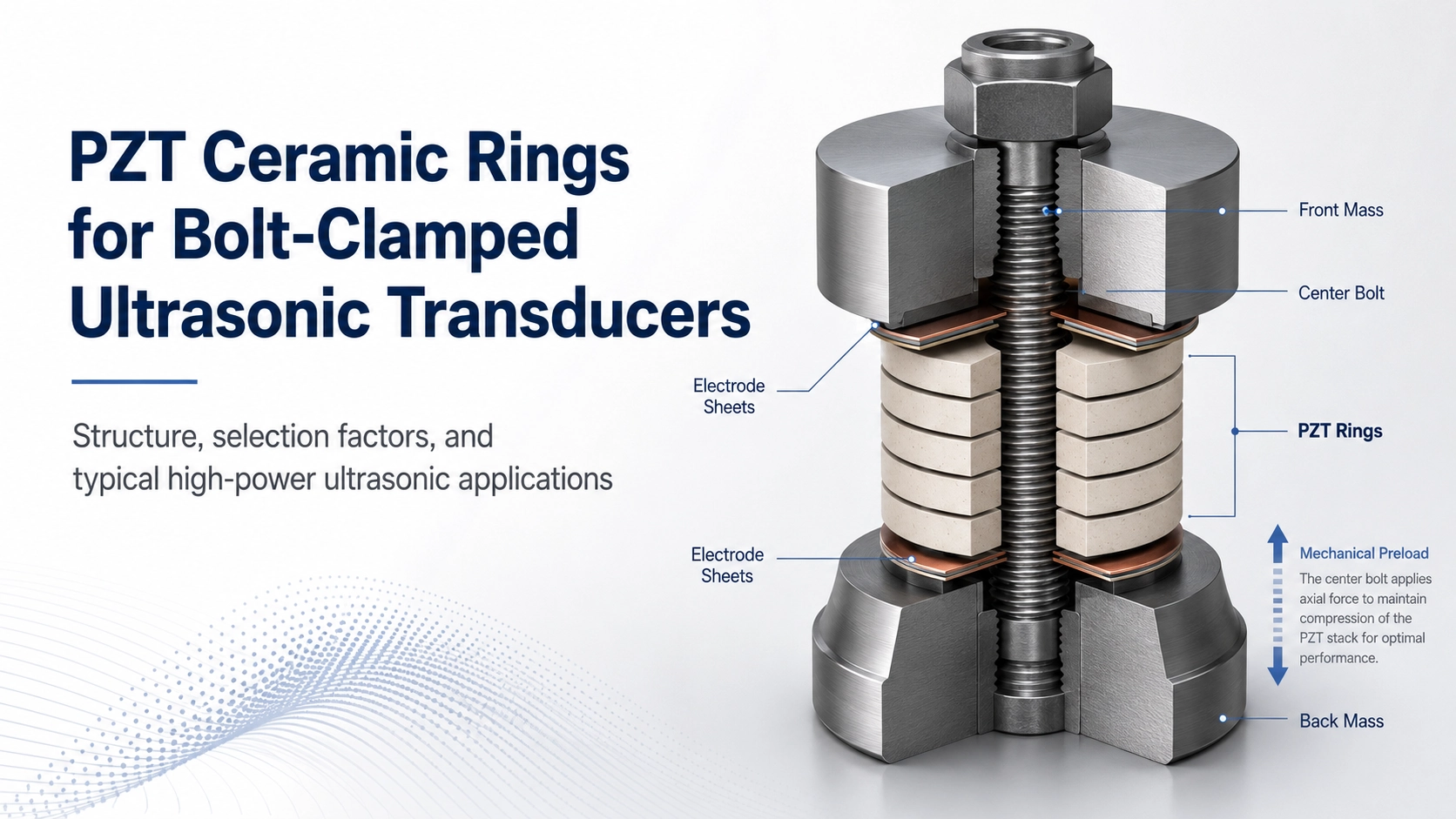
PZT ceramic rings are commonly used in bolt-clamped ultrasonic transducers because the center hole allows a central bolt to pass through the ceramic stack. This structure makes it possible to apply mechanical preload, align multiple ceramic rings, and clamp the active piezoelectric elements between the front and back metal masses.
In a typical bolt-clamped ultrasonic transducer, the stack may include a front mass, a back mass, several PZT rings, electrode sheets, insulating parts, and a central bolt. The bolt applies compression to the ceramic rings. This is important because piezo ceramic rings perform better mechanically when tensile stress is reduced during high-power vibration.
Compared with a simple bonded ceramic disc, a ring-shaped ceramic is more suitable when the transducer design requires a central mechanical path. The hole can be used for preloading, alignment, insulation, or assembly around a rod or bolt. This is why PZT rings for ultrasonic transducers are widely used in high-power ultrasonic cleaning, welding, cutting, and other resonant systems.
For readers comparing different ceramic geometries, the article PZT discs vs rings vs plates vs tubes explains how shape affects vibration mode, mounting method, and application suitability.
How PZT Rings Work in a High-Power Ultrasonic Stack
In a high-power ultrasonic transducer, PZT ceramic rings convert electrical energy into mechanical vibration. When an alternating voltage is applied across the electrodes, the polarized ceramic expands and contracts at the driving frequency. In a bolt-clamped structure, this motion is transmitted through the metal masses and becomes part of the complete resonant vibration system.
The ceramic ring itself does not determine the final performance alone. The output of a bolt-clamped ultrasonic transducer depends on the combined design of the PZT rings, front mass, back mass, preload, electrode connection, generator matching, and working load. A ceramic ring that performs well in one structure may not produce the same result in another transducer design.
For this reason, selecting piezo ceramic rings requires more than matching an outside diameter and thickness. The buyer should also consider material grade, resonant frequency, capacitance, electrode design, polarization direction, mechanical tolerances, and the intended operating condition.
Key Parameters When Specifying PZT Ceramic Rings
Outside Diameter, Inside Diameter, and Thickness
The basic dimensions of PZT ceramic rings are usually specified as outside diameter, inside diameter, and thickness. These dimensions affect the mechanical structure, electrical capacitance, frequency behavior, and assembly method of the transducer.
The inside diameter must match the central bolt, insulating sleeve, and required assembly clearance. If the inside diameter is too small, the ceramic ring may be difficult to assemble or may experience unwanted mechanical contact. If it is too large, the effective ceramic area is reduced, which can affect capacitance and energy conversion.
The outside diameter should match the contact area of the metal masses and the intended power level of the transducer design. The thickness affects electric field strength, working voltage, stack length, and frequency-related design calculations. When requesting PZT ceramic rings, it is better to provide the full ring size in the form of OD × ID × thickness, rather than only giving one dimension.
Material Grade: Hard PZT Is Usually Preferred
For a high-power ultrasonic transducer, hard PZT rings are usually preferred over soft PZT materials. Hard PZT generally offers higher mechanical quality factor, lower dielectric loss, and better stability under strong resonant drive. These characteristics are important in applications where the ceramic must operate continuously or under high mechanical stress.
Soft PZT materials are often selected for applications that require higher sensitivity, larger low-field response, or receiving performance. However, they are not always suitable for power ultrasonic systems where heat generation, drive stability, and mechanical loss are major concerns.
For applications such as ultrasonic cleaning and ultrasonic welding, hard PZT rings are commonly considered first. The final choice should still be checked against the required frequency, drive level, duty cycle, operating temperature, and full transducer structure. For a broader explanation of hard and soft materials, see the PZT material selection guide.
Resonant Frequency and Stack Design
The resonant frequency of a bolt-clamped ultrasonic transducer is not determined by the ceramic ring alone. Ring dimensions influence the design, but the final resonant frequency depends on the complete stack, including the metal masses, bolt preload, ceramic quantity, electrode layers, and any connected horn or load.
When selecting PZT rings for ultrasonic transducers, it is useful to distinguish between two requirements. One is the ceramic component requirement, such as ring size, capacitance, material, and electrode configuration. The other is the complete transducer requirement, such as target frequency, impedance, amplitude, and working power.
If the buyer already has a drawing, the ceramic supplier can review manufacturability and dimensional tolerance. If the buyer only has a target transducer frequency, more design information is needed before the ceramic ring dimensions can be recommended.
Electrode Design and Polarization Direction
Most PZT ceramic rings used in bolt-clamped ultrasonic transducers have electrodes on the two large flat faces and are polarized through the thickness direction. This configuration allows the ceramic rings to be stacked with electrode sheets between them and driven by an alternating voltage.
Electrode details should be confirmed before production. Important points include electrode material, electrode coverage, soldering area, insulation clearance near the inner hole, and whether the electrode must avoid certain mechanical contact areas.
Polarization direction must also be consistent with the electrical connection and stack assembly. In a multi-ring stack, incorrect polarity arrangement can reduce output or cause unstable performance. The drawing or quotation request should clearly indicate polarization direction if the assembly has specific requirements.
Tolerances and Surface Quality
Dimensional tolerances are important because PZT ceramic rings are clamped between metal parts. Outside diameter, inside diameter, thickness, parallelism, flatness, and surface condition can affect contact quality and preload distribution.
In a high-power ultrasonic stack, uneven contact may lead to local stress concentration, heat generation, unstable frequency behavior, or reduced service life of the assembled transducer. For this reason, the required tolerance should be defined according to assembly design, frequency consistency, and batch production requirements.
If the project requires custom dimensions, special electrodes, or controlled tolerances, the article on custom piezo ceramic components provides more information about supported shapes, dimensions, materials, electrodes, and quotation details.
Typical Applications of Bolt-Clamped Ultrasonic Transducers Using PZT Rings
Ultrasonic Cleaning Transducers
PZT rings for ultrasonic cleaning are commonly used in bolt-clamped transducer stacks where stable resonant operation and continuous vibration are required. In industrial cleaning systems, the ceramic rings must support repeated electrical drive and mechanical vibration while controlling heat generation and frequency drift.
For ultrasonic cleaning, the material is often selected with attention to mechanical quality factor, dielectric loss, temperature behavior, and compatibility with the complete transducer structure. The ring geometry allows the ceramic stack to be mechanically preloaded, which is useful in high-power cleaning applications.
For more details on this application, see PZT ceramics for ultrasonic cleaning transducers.
Ultrasonic Welding and Cutting Transducers
PZT rings for ultrasonic welding and cutting are used in transducers that must transfer mechanical vibration through boosters, horns, or cutting tools. These applications often place higher demands on power handling, mechanical coupling, frequency stability, and thermal behavior.
In these systems, hard PZT rings are commonly considered because the ceramic stack operates under strong resonant drive. However, the ceramic ring should not be evaluated separately from the horn, booster, generator, and mechanical load. The complete system design determines the final amplitude, impedance, and operating stability.
Sonochemistry, Extraction, and Other Power Ultrasonic Systems
Other power ultrasonic systems may also use bolt-clamped ultrasonic transducers with piezo ceramic rings. These include sonochemistry, extraction, dispersion, emulsification, and other liquid-processing applications.
Although these systems differ in structure and working medium, they often share similar requirements: resonant operation, stable energy transfer, controlled heat generation, and mechanical durability under continuous or repeated drive. For these cases, the PZT ceramic rings should be specified together with the target frequency, duty cycle, working environment, and mechanical assembly requirements.
PZT Rings vs PZT Discs in Ultrasonic Transducer Design
PZT rings and PZT discs are both common piezoelectric ceramic shapes, but they are used in different mechanical structures. PZT discs are often used in simpler circular designs, bonded transducers, sensors, buzzers, or applications where no central bolt is required.
PZT ceramic rings are more suitable when the transducer requires a center hole for a bolt, rod, tube, or mechanical preload structure. In a bolt-clamped ultrasonic transducer, the ring shape allows multiple ceramic elements to be stacked and compressed around a central bolt.
This does not mean that rings are always better than discs. The correct geometry depends on the vibration mode, mounting method, frequency, output requirement, and assembly design. For bonded low-power structures, a disc may be more practical. For preloaded high-power stacks, a ring is often more appropriate.
| Item | PZT Ceramic Rings | PZT Ceramic Discs |
|---|---|---|
| Center hole | Available for bolt, rod, or preload structure | No center hole in standard disc form |
| Typical assembly | Bolt-clamped stack | Bonded or mechanically mounted structure |
| Common applications | Ultrasonic cleaning, welding, cutting, power ultrasonic systems | Sensors, buzzers, atomizers, bonded transducers |
| Main design concern | Preload, inner hole clearance, stack alignment, contact quality | Bonding surface, diameter, thickness, vibration mode |
Information to Provide When Requesting PZT Ceramic Rings
To evaluate or quote PZT ceramic rings accurately, the supplier needs more than a product name. A complete request should include the ceramic dimensions, intended application, electrical requirements, and mechanical assembly conditions.
The following information is useful when preparing a quotation:
- Application, such as ultrasonic cleaning, ultrasonic welding, ultrasonic cutting, or another high-power ultrasonic system
- Target transducer frequency or existing design frequency
- Ring dimensions, including outside diameter, inside diameter, and thickness
- Preferred material grade, such as hard PZT for high-power operation
- Required capacitance, if already defined
- Electrode material and electrode coverage
- Polarization direction
- Dimensional tolerances and surface requirements
- Quantity for prototype or batch production
- Operating condition, including voltage, duty cycle, temperature, and working medium
- Available drawings, samples, or existing transducer specifications
If the PZT rings are part of a custom transducer project, it is also helpful to provide information about the metal masses, bolt size, insulation structure, and assembly method. This allows the ceramic specifications to be reviewed in the context of the complete bolt-clamped ultrasonic transducer rather than as an isolated component.
Conclusion
PZT ceramic rings are used in bolt-clamped ultrasonic transducers because their center hole supports mechanical preload, stack alignment, and high-power transducer assembly. For ultrasonic cleaning, welding, cutting, and other power ultrasonic systems, the ceramic ring must be selected together with the full stack structure.
Important factors include ring dimensions, hard PZT material selection, resonant frequency, electrode design, polarization direction, tolerances, and operating conditions. A clear drawing and application description are usually more useful than requesting a standard ring size without context.
If you are specifying PZT rings for ultrasonic transducers, provide the ring dimensions, target frequency, material preference, electrode requirements, quantity, and working conditions. These details help determine whether the ceramic ring specifications are suitable for manufacturing and further transducer evaluation.