Why PZT Ceramic Discs Are Used in Ultrasonic Sensors and Transducers
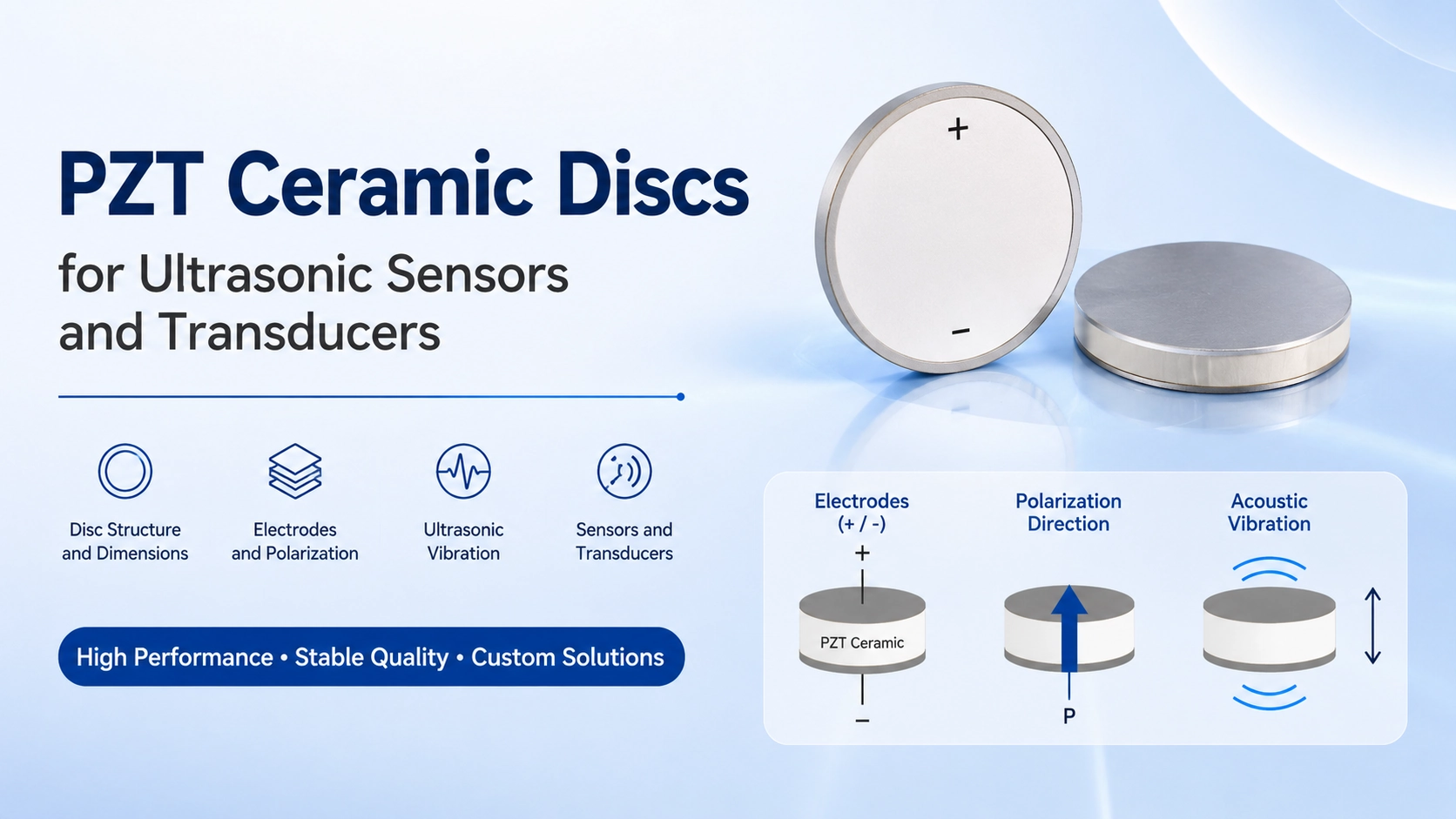
PZT ceramic discs are commonly used in ultrasonic sensors and compact transducers because their flat circular geometry is easy to electrode, polarize, bond, and integrate into acoustic assemblies. In many sensor designs, the disc works as the active element that converts electrical signals into ultrasonic vibration, receives acoustic energy and converts it back into an electrical signal, or performs both functions in one structure.
Compared with more complex ceramic shapes, a disc is suitable when the device requires a simple circular active area, a bonded structure, or a compact single-element transducer. It does not have a center hole, so it is usually not selected for bolt-clamped stacks. Instead, it is more often used in sensors, measurement devices, buzzers, atomizers, and small ultrasonic components where a flat ceramic element can be bonded to a metal diaphragm, housing, backing layer, or acoustic surface.
For standard and custom shapes used in ultrasonic devices, see our PZT ceramic products for ultrasonic devices.
How a PZT Ceramic Disc Works in an Ultrasonic Device
A PZT ceramic disc is a piezoelectric element. When an alternating voltage is applied across its electrodes, the polarized ceramic produces small mechanical deformation. If the disc is used as a transmitter, this deformation generates ultrasonic vibration. If the disc is used as a receiver, incoming pressure waves or mechanical vibration generate an electrical signal through the direct piezoelectric effect.
This conversion process is reversible, which is why piezoelectric ceramics are used in both ultrasonic transmitters and receivers. For a general explanation of the piezoelectric effect, the Wikipedia entry on piezoelectricity provides useful background.
In a practical ultrasonic device, however, the disc does not work as an isolated part. Its performance is affected by the ceramic material, diameter, thickness, electrode design, polarization direction, bonding layer, housing, backing material, matching layer, circuit, and working medium. The same PZT disc may show different resonance behavior after it is assembled into different structures.
For this reason, selecting PZT ceramic discs requires both ceramic component information and application information. A disc used in an air-coupled proximity sensor will not be specified in the same way as a disc used in a liquid-level sensor or a compact contact transducer.
Key Parameters When Selecting PZT Ceramic Discs
Diameter and Thickness
The basic dimensions of PZT ceramic discs are usually specified as diameter and thickness. Diameter affects the active area, capacitance, acoustic aperture, mounting space, and mechanical integration. A larger diameter may provide a larger active surface, but it also changes capacitance, vibration behavior, and packaging requirements.
Thickness is closely related to electric field strength, working voltage, and thickness-mode resonance. In general, thinner discs are associated with higher thickness-mode frequencies, while thicker discs are associated with lower frequencies. This relationship is useful as a first design reference, but the final operating frequency still depends on the complete device structure.
When requesting PZT ceramic discs, it is better to provide the full size as diameter × thickness. If the disc has a special edge requirement, center mark, surface finish, or electrode pattern, these details should also be included in the drawing or specification.
Resonant Frequency and Vibration Mode
PZT ceramic discs may work in thickness mode, radial mode, bending-related structures, or other coupled vibration modes depending on the device design. The intended vibration mode should be considered before choosing disc dimensions.
For example, a disc bonded to a metal diaphragm may behave differently from a free ceramic disc. A disc assembled with backing material, matching layer, adhesive, or a housing will also show changes in resonance frequency, impedance, bandwidth, and sensitivity. This is why the frequency of the ceramic element and the working frequency of the finished transducer should not be treated as the same value unless the structure is already defined.
If the project already has an existing drawing, the ceramic supplier can review size, tolerance, electrode, and manufacturability. If the project only has a target sensor frequency, more information about the housing, bonding method, acoustic path, and working medium is needed.
Material Grade and Electrical Performance
Material selection depends on how the disc is used. For receiving sensors, the design may prioritize sensitivity, capacitance, dielectric constant, and signal response. For transmitting elements or higher-drive transducers, loss, heat generation, mechanical quality factor, and stability under drive become more important.
Soft PZT materials are often considered for higher sensitivity and stronger small-signal response. Hard PZT materials are usually considered when lower loss, higher mechanical quality factor, and stronger drive stability are required. The correct choice depends on whether the disc is used mainly for transmitting, receiving, or both.
For more details on soft and hard materials, see our PZT material selection guide.
Electrode Design and Polarization Direction
Most PZT ceramic discs use electrodes on the two large flat faces and are polarized through the thickness direction. This is a common structure for ultrasonic sensors and compact transducers because it is simple to connect and easy to integrate into bonded assemblies.
Electrode details should be confirmed before production. Important points include electrode material, electrode coverage, soldering area, lead attachment method, edge clearance, and whether the electrode needs to avoid certain bonding or insulation areas.
Polarization direction must match the electrical drive and mechanical assembly. In some sensor structures, polarity direction affects signal phase and system consistency. If multiple discs are used in one device or batch consistency is important, polarization marking should be defined clearly.
Tolerances, Surface Quality, and Bonding Conditions
Dimensional tolerance is important because disc thickness and diameter can influence frequency consistency, capacitance range, and assembly fit. For sensor and measurement applications, batch consistency is often as important as a single nominal value.
Surface quality also matters. Many PZT ceramic discs are bonded to metal diaphragms, housings, acoustic layers, or other structural parts. Flatness, surface condition, and edge quality can affect adhesive layer thickness, acoustic coupling, and mechanical reliability.
Bonding conditions should be considered during specification. Adhesive type, bonding area, curing temperature, pressure, and surface preparation can all affect the final device performance. If a project has strict frequency or sensitivity requirements, the ceramic disc should be evaluated together with the bonding and assembly process.
Typical Applications of PZT Ceramic Discs
Ultrasonic Distance and Proximity Sensors
PZT discs for ultrasonic sensors are often used as transmitting or receiving elements in distance and proximity detection devices. In these applications, the disc may generate acoustic pulses, receive echoes, or operate in a combined transmit-receive structure.
Important design factors include operating frequency, sensitivity, beam direction, acoustic matching, housing design, and circuit impedance. Air-coupled sensors, liquid-coupled sensors, and contact sensors require different disc specifications and assembly methods.
Flow, Level, and Thickness Measurement
PZT ceramic discs are also used in flow, level, and thickness measurement systems. These applications often require stable frequency behavior, repeatable signal response, and suitable acoustic coupling to liquid, solid, or contact surfaces.
The disc size, material grade, electrode design, and bonding method should be selected together with the housing, medium, signal path, and electronics. Measurement accuracy depends on the complete system, not only on the ceramic disc.
Compact Ultrasonic Transducers
In compact ultrasonic transducers, PZT ceramic discs can be combined with backing layers, matching layers, metal cases, membranes, or acoustic windows. The disc provides the active electromechanical conversion, while the surrounding structure controls bandwidth, directionality, damping, and acoustic coupling.
For a useful overview of ultrasonic transducer elements and their function, the NDE Resource Center page on piezoelectric transducers explains how the active element converts electrical energy to acoustic energy and vice versa.
Atomizers, Buzzers, and Small Acoustic Devices
Some PZT ceramic discs are used in atomizers, buzzers, alarms, and other compact acoustic or vibration devices. These applications may focus on size, drive voltage, frequency, bonding method, sound output, vibration amplitude, or service conditions.
The ceramic disc should be specified according to the actual structure. A disc bonded to a metal diaphragm for a buzzer is different from a disc used in a sensor or a liquid atomization structure. Even when the same nominal diameter and thickness are used, the final performance may change significantly after assembly.
When to Use PZT Discs Instead of Rings, Plates, or Tubes
PZT ceramic discs are suitable when the design needs a flat circular active element, a bonded structure, or a compact sensor assembly without a central bolt. They are often selected for sensors, single-element transducers, acoustic devices, and small electromechanical structures.
PZT rings are more suitable when the design requires a center hole, mechanical preload, or a bolt-clamped stack. For high-power ultrasonic structures using a central bolt, see our article on PZT ceramic rings for bolt-clamped ultrasonic transducers.
PZT plates are more suitable for rectangular or flat patch structures, while PZT tubes are used when the design requires a cylindrical ceramic element, radial deformation, or a tube-like assembly path. For a broader geometry comparison, see PZT discs vs rings vs plates vs tubes.
| Geometry | Typical Structure | Common Use Case |
|---|---|---|
| PZT ceramic discs | Flat circular element | Ultrasonic sensors, compact transducers, buzzers, atomizers |
| PZT ceramic rings | Center hole for bolt or mechanical path | Bolt-clamped ultrasonic transducers, high-power stacks |
| PZT ceramic plates | Rectangular or flat patch structure | Patch transducers, bending structures, custom assemblies |
| PZT ceramic tubes | Cylindrical ceramic element | Tube-based sensors, radial structures, special transducers |
Information to Provide When Requesting PZT Ceramic Discs
To evaluate or quote PZT ceramic discs accurately, the supplier needs more than a product name. The request should include ceramic dimensions, target application, electrical requirements, mechanical assembly conditions, and quantity.
The following information is useful when preparing a quotation:
- Application, such as ultrasonic sensor, compact transducer, flow meter, level sensor, atomizer, or buzzer
- Working medium, such as air, liquid, solid contact, or enclosed structure
- Target frequency or existing resonance requirement
- Disc dimensions, including diameter and thickness
- Material preference or performance priority, such as sensitivity, stability, or low loss
- Required capacitance or impedance range, if already defined
- Electrode material, coverage, and soldering or lead attachment method
- Polarization direction and marking requirement
- Dimensional tolerances and surface quality requirements
- Bonding or mounting method
- Prototype quantity or batch production quantity
- Operating conditions, including voltage, duty cycle, temperature, humidity, and medium
- Available drawings, samples, or existing part numbers
If the disc is used in a custom sensor or transducer assembly, it is helpful to provide information about the housing, backing layer, matching layer, bonding surface, and acoustic path. These details make it easier to review whether the ceramic disc specification is suitable for manufacturing and device evaluation.
Conclusion
PZT ceramic discs are widely used in ultrasonic sensors and compact transducers because their flat circular geometry is easy to electrode, polarize, bond, and integrate into acoustic assemblies. They can work as transmitters, receivers, or combined transmit-receive elements depending on the device structure.
When selecting PZT ceramic discs, important factors include diameter, thickness, resonant frequency, vibration mode, material grade, electrode design, polarization direction, tolerance, surface quality, and bonding conditions. The disc should be evaluated together with the complete sensor or transducer structure, rather than as an isolated ceramic part.
For quotation or project review, provide the disc dimensions, target frequency, application, material preference, electrode requirements, quantity, and working conditions. These details help determine whether the ceramic disc specifications are suitable for prototype development, replacement, or batch production.