Why Clear Specifications Matter for Custom PZT Ceramic Components
Custom PZT ceramic components are often requested when a standard disc, ring, plate, or tube cannot meet the mechanical, electrical, or assembly requirements of a device. In these projects, a clear specification is more important than a general product name. A request such as “we need custom piezo ceramic parts” is usually not enough for accurate quotation or manufacturability review.
PZT ceramics are functional components, not only machined shapes. Their final performance is affected by material grade, geometry, dimensions, tolerances, electrodes, polarization direction, frequency, capacitance, operating environment, and assembly method. If these details are unclear, the quotation may require several rounds of clarification, and the first sample may not match the actual application requirement.
A good quotation request should help the supplier understand two things: what the ceramic part should be, and how it will be used. The first part includes shape, size, material, electrodes, and tolerances. The second part includes application, frequency, drive condition, working medium, and production quantity.
Start with the Application and Working Conditions
The first step is to explain the application. A custom PZT ceramic component used in an ultrasonic cleaning transducer is different from one used in a sensor, actuator, atomizer, medical ultrasound probe, or flow measurement device. Even if two parts have similar dimensions, the material and performance requirements may be different.
Useful application information includes the device type, whether the ceramic is used for transmitting, receiving, sensing, actuation, or power conversion, and whether the component works in air, liquid, solid contact, or an enclosed structure. This helps determine whether the project should prioritize sensitivity, low loss, mechanical strength, frequency stability, or high-power drive behavior.
Working conditions should also be included. Voltage, duty cycle, operating temperature, humidity, pressure, bonding method, and working medium can all affect material selection and design review. For high-power ultrasonic devices, heat generation and mechanical stress are especially important. For sensor applications, signal response and consistency may be more important.
Define the Ceramic Shape and Dimensions
Common Custom Shapes
Custom PZT ceramic components may include discs, rings, plates, tubes, hemispherical ceramics, bowl-shaped ceramics, stave segments, and other non-standard geometries. The selected shape should match the vibration mode, mounting method, and device structure.
For example, a disc is often used when the design requires a flat circular active area. A ring is more suitable when the structure requires a center hole for a bolt, rod, tube, or mechanical preload path. A plate may be used for rectangular or patch-type assemblies, while a tube is useful for cylindrical structures or radial deformation designs.
If the project is still at the geometry selection stage, the article PZT discs vs rings vs plates vs tubes explains how common PZT ceramic shapes differ in structure and application suitability.
Dimensions and Drawing Requirements
Dimensions should be provided clearly. For discs, this usually means diameter and thickness. For rings, it means outside diameter, inside diameter, and thickness. For plates, length, width, and thickness are required. For tubes, outside diameter, inside diameter, and length should be specified.
For non-standard shapes, a technical drawing is strongly recommended. The drawing should define critical dimensions, tolerances, electrode areas, polarization direction, surface requirements, and any special edges, holes, chamfers, grooves, or curved surfaces. A simple sketch can help in the early discussion, but a formal drawing is usually needed before production confirmation.
If the component is based on an existing part, a sample or previous part number can also be useful. However, a physical sample should not replace a specification. Materials, electrodes, and polarization may not be obvious from the appearance of the sample.
Select the PZT Material Based on Performance Requirements
Material selection should be based on the function of the ceramic component. Some applications need higher sensitivity and stronger small-signal response. Others need lower loss, higher mechanical quality factor, better drive stability, or improved thermal behavior.
Soft PZT materials are often considered for sensing, receiving, and low-power signal applications. Hard PZT materials are usually considered for power ultrasonic devices, resonant drive systems, and applications where heat generation and mechanical loss must be controlled. The correct choice depends on the complete operating condition, not only on the material name.
For a broader explanation of material differences and selection logic, see the PZT material selection guide.
When requesting a quotation, it is useful to provide either the required material grade or the performance priority. If the exact grade is not known, describe the application and key requirements instead. For example, specify whether the design needs high sensitivity, high Qm, low dielectric loss, high capacitance, temperature stability, or strong-drive capability.
Specify Tolerances, Surface Quality, and Mechanical Details
Tolerances affect both manufacturing feasibility and final device performance. In PZT ceramics, thickness tolerance can influence frequency and capacitance. Outer dimensions affect assembly fit. Flatness, parallelism, roundness, and concentricity may be important when the ceramic is bonded, clamped, stacked, or aligned with other components.
It is not always useful to request the tightest possible tolerance. Very strict tolerances may increase processing difficulty, cost, and lead time. The better approach is to identify which dimensions are critical to the device and which dimensions can follow standard production tolerances.
Surface quality should also be defined when the ceramic will be bonded, clamped, or acoustically coupled. Surface finish, flatness, edge chips, cracks, and contamination can affect bonding strength, acoustic coupling, and reliability. For components used in high-power or high-frequency devices, surface and edge quality should be reviewed carefully.
Technical drawings often use standardized dimensioning and tolerancing methods. For general background on engineering drawing and tolerancing principles, the ISO GPS standard framework provides a reference for how dimensional and geometrical specifications are managed in engineering documentation.
Confirm Electrode Design and Polarization Direction
Electrode design should be confirmed before quotation. Common information includes electrode material, electrode coverage, soldering area, insulation clearance, edge margin, and whether one or more surfaces should remain unelectroded.
For simple discs and plates, electrodes are often applied on the two large flat faces. For rings, electrodes are usually applied on the two annular faces. For tubes or special shapes, electrode placement can be more complex and should be shown in the drawing.
Polarization direction is equally important. Many PZT components are polarized through the thickness direction, but this should not be assumed for every custom part. The polarization direction must match the electrical drive, vibration mode, and assembly design. If polarity marking is required, it should also be stated clearly.
Incorrect electrode layout or unclear polarization direction can cause assembly errors, reduced output, phase inconsistency, or incorrect signal response. For batch production, electrode and polarization marking should be standardized to reduce handling mistakes.
Clarify Frequency, Capacitance, and Electrical Requirements
Electrical requirements help determine whether the custom PZT ceramic component can meet the intended device design. Common parameters include resonant frequency, capacitance, dielectric loss, coupling factor, insulation resistance, and material constants such as d33 or Qm.
It is important to clarify whether the required frequency refers to the ceramic element alone or the finished assembly. A PZT ceramic disc, ring, plate, or tube may show one frequency before assembly and a different working frequency after bonding, clamping, housing, or loading.
If capacitance is important for circuit matching, the required capacitance range should be provided. If the ceramic is used in a resonant system, impedance and frequency behavior may also need to be checked. For high-power applications, loss and heat generation should be considered together with the drive condition.
For general terminology related to piezoelectric constants and measurements, the IEEE Standard on Piezoelectricity is a useful technical reference.
Provide Quantity, Prototype Stage, and Production Expectations
Quantity affects quotation, tooling decisions, inspection planning, and production method. A prototype order may focus on design verification and manufacturability. A batch order may require tighter process control, inspection criteria, packaging requirements, and consistency across production lots.
It is useful to state whether the request is for initial samples, engineering validation, pilot production, or mass production. If the project is still in early development, the supplier may need to review several design options. If the project is already finalized, the quotation can be based on drawings, fixed tolerances, and defined inspection requirements.
Production expectations should include target quantity, expected annual usage, packaging requirements, documentation needs, and any special testing requirements. If the component will be assembled with other parts, it is also helpful to explain whether the ceramic will be bonded, soldered, clamped, potted, or integrated into a larger module.
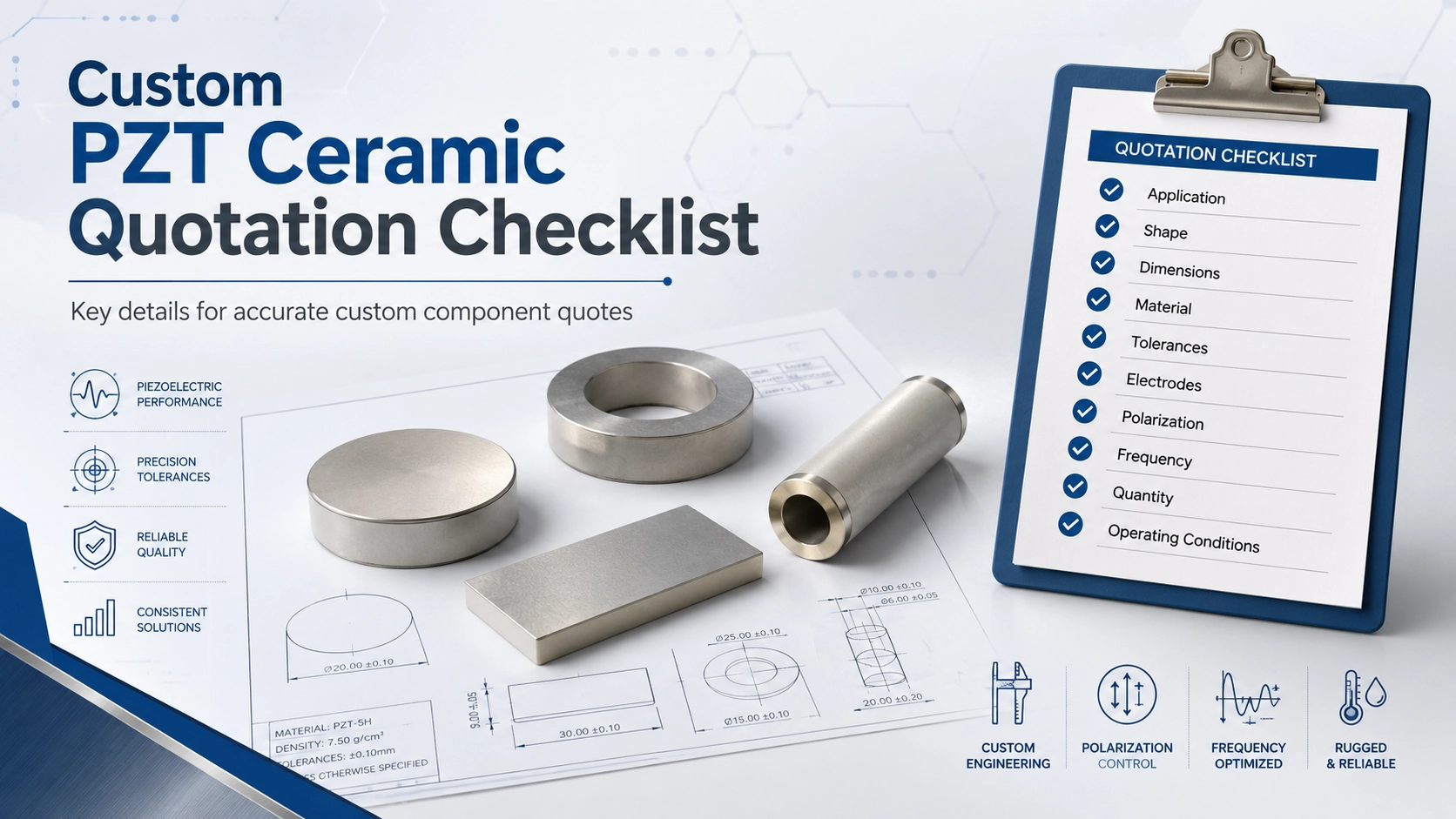
Custom PZT Quotation Checklist
The following checklist can be used when preparing a quotation request for custom PZT ceramic components:
| Specification Item | Information to Provide | Why It Matters |
|---|---|---|
| Application | Sensor, transducer, actuator, atomizer, ultrasonic cleaning, welding, flow measurement, or other use | Helps determine material, performance priority, and operating condition |
| Shape | Disc, ring, plate, tube, bowl, hemisphere, stave, or custom geometry | Affects vibration mode, manufacturing process, and assembly method |
| Dimensions | Diameter, thickness, OD, ID, length, width, height, radius, or drawing-defined dimensions | Required for manufacturability review and quotation |
| Material | Known PZT grade or required performance priority | Determines sensitivity, loss, Qm, capacitance, and drive behavior |
| Tolerances | Critical and non-critical dimensional tolerances | Affects processing difficulty, assembly fit, and cost |
| Electrodes | Material, coverage, soldering area, edge clearance, and special patterns | Controls electrical connection and assembly compatibility |
| Polarization | Polarization direction and marking requirement | Ensures correct electrical and mechanical response |
| Electrical Parameters | Frequency, capacitance, dielectric loss, impedance, or other requirements | Supports circuit matching and device performance review |
| Operating Conditions | Voltage, duty cycle, temperature, humidity, medium, pressure, and load | Helps evaluate material suitability and reliability risks |
| Quantity | Prototype quantity, batch quantity, or expected annual usage | Affects quotation, production planning, and inspection method |
| Files or Samples | Drawing, CAD file, sample, photo, or existing part number | Reduces ambiguity and shortens technical communication |
If the project requires non-standard geometry, special electrodes, custom tolerances, or application-specific review, the page on custom piezo ceramic components provides more information about supported shapes, dimensions, materials, and customization options.
Example of a Clear Custom PZT Quotation Request
A clear quotation request does not need to be long, but it should include the key engineering information. For example:
Example request: We need custom PZT ceramic rings for an ultrasonic transducer prototype. The required size is OD 25 mm × ID 10 mm × thickness 5 mm. The application is a high-power resonant transducer operating around 40 kHz. Hard PZT material is preferred. Electrodes are required on both flat annular faces, with thickness-direction polarization. Prototype quantity is 50 pieces. A drawing is attached for dimensional tolerance and electrode coverage.
This type of request gives the supplier enough information to evaluate material direction, geometry, electrode design, production feasibility, and quotation conditions. Additional details may still be needed, but the first review can begin without guessing the basic requirements.
Common Problems in Custom PZT Requests
Several issues can delay quotation or sample confirmation. One common problem is providing only the application name without dimensions or drawings. Another is giving a target frequency without explaining whether it refers to the ceramic element or the finished device. A third issue is requesting very tight tolerances without identifying which dimensions are functionally critical.
Electrode and polarization details are also often missed. For custom PZT ceramics, these details can be as important as the mechanical dimensions. If the ceramic is assembled incorrectly or the electrode layout does not match the device structure, the part may not function as intended even if the shape and size are correct.
To reduce delays, the quotation request should separate known requirements from open questions. If the material grade is not confirmed, describe the application and performance priority. If the final frequency is still under development, explain the current design stage. If drawings are preliminary, mark them as preliminary rather than final production drawings.
Conclusion
Specifying custom PZT ceramic components requires more than selecting a shape and size. A useful quotation request should define the application, working conditions, material requirements, dimensions, tolerances, electrodes, polarization direction, frequency, capacitance, quantity, and available drawings or samples.
Clear specifications help reduce communication time, improve quotation accuracy, and make prototype development more efficient. They also help identify manufacturability issues before production begins.
If you are preparing a custom PZT ceramic quotation request, provide the drawing, application, target performance, quantity, and operating conditions together. These details allow the ceramic specifications to be reviewed in the context of the actual device, rather than as an isolated ceramic part.