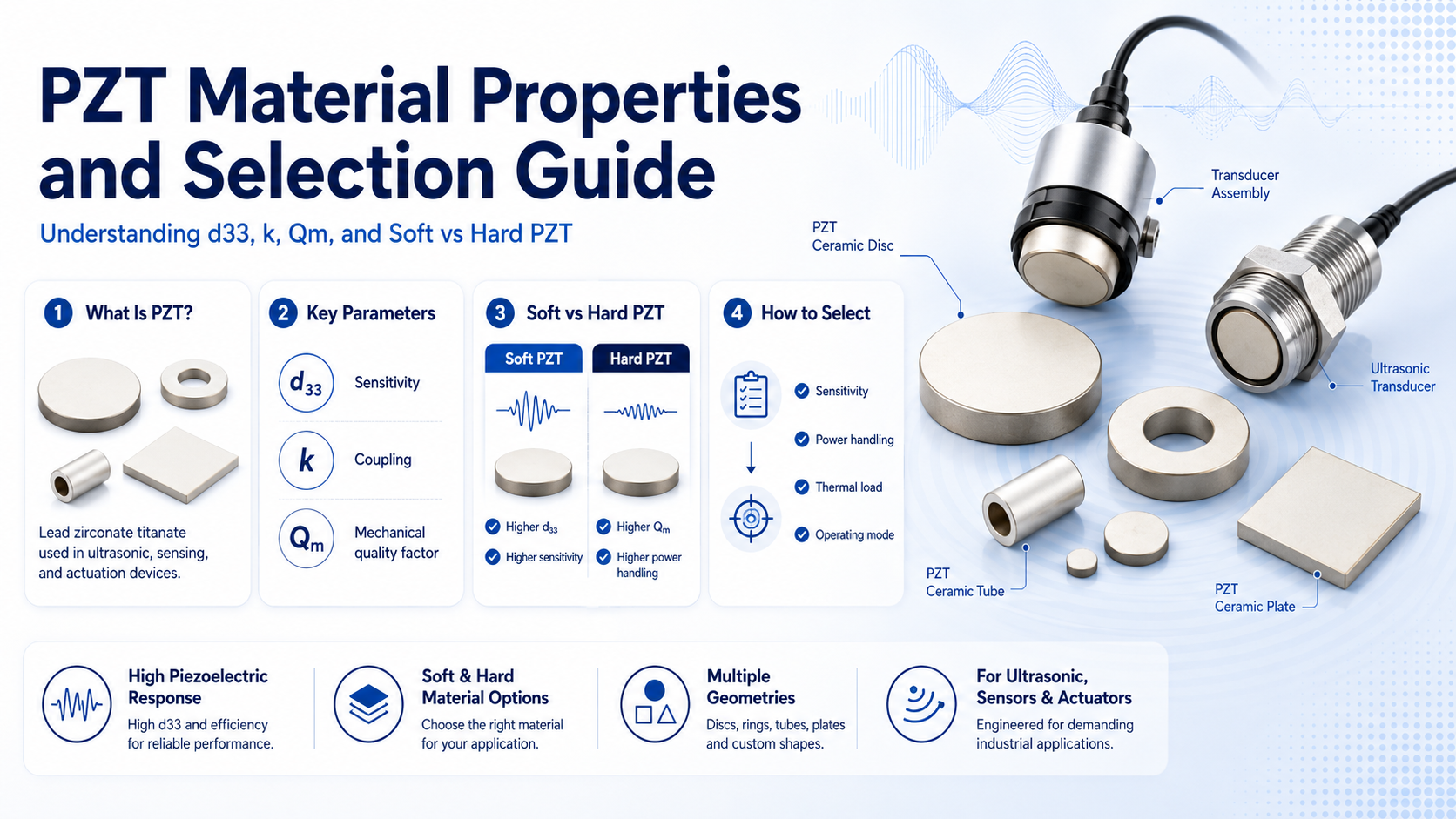
PZT material, short for lead zirconate titanate, is one of the most widely used piezoelectric ceramics in modern ultrasonic, sensing, and actuation applications. It combines strong piezoelectric response, high dielectric performance, and good electromechanical conversion efficiency, which is why it remains a standard choice for medical ultrasound, industrial transducers, sensors, actuators, atomizers, buzzers, and precision devices.
At Hurricane PZT, we manufacture a wide range of piezoelectric ceramic components for ultrasonic and industrial applications, including discs, rings, plates, tubes and other components.
What Is PZT Material?
PZT stands for lead zirconate titanate, a piezoelectric ceramic with the chemical formula Pb(ZrxTi1−x)O3. It is a solid solution of lead zirconate and lead titanate. By adjusting the zirconium-to-titanium ratio and adding selected dopants, manufacturers can tune the material for higher sensitivity, higher power handling, lower loss, or better thermal stability.
This tunability is one of the main reasons PZT is used so widely. Compared with many other piezoelectric materials, it offers a better balance of performance, manufacturability, and cost for commercial devices.
Why PZT Is So Widely Used
PZT remains the dominant piezoelectric ceramic because it offers a combination of properties that engineers care about most: strong charge response, efficient electromechanical conversion, broad design flexibility, and compatibility with many shapes and fabrication methods.
- High piezoelectric activity for sensing and actuation
- Strong electromechanical coupling for efficient energy conversion
- Available in soft and hard material systems
- Suitable for discs, rings, tubes, plates, blocks, and custom structures
- Proven use in ultrasonic, industrial, and medical applications
What Do d33, k, and Qm Mean?
When selecting a PZT material, three parameters appear again and again: d33, k, and Qm. These values do not describe exactly the same thing, so understanding the difference is essential.
d33: Piezoelectric Charge Coefficient
d33 describes how much electric charge is generated in the polarization direction when mechanical stress is applied, or how much strain is produced in that same direction when an electric field is applied. In practical terms, a higher d33 usually means a more sensitive material or a material capable of producing larger displacement at a given drive level.
If your design priority is sensitivity, response amplitude, or low-voltage actuation, d33 is often one of the first values to check.
k: Electromechanical Coupling Coefficient
The electromechanical coupling coefficient, often written as kp, k33, or kt depending on vibration mode, indicates how efficiently the material converts electrical energy into mechanical energy and back again. Higher coupling usually benefits transducers and resonant devices because more of the input energy participates in the desired vibration mode.
For ultrasonic transducers, coupling is often just as important as d33, especially when bandwidth, resonance behavior, and conversion efficiency matter.
Qm: Mechanical Quality Factor
Qm is a measure of mechanical loss under resonance. A higher Qm generally means lower mechanical loss, narrower resonance behavior, and better suitability for high-power or continuous-drive operation. A lower Qm usually corresponds to broader bandwidth and higher internal loss.
In simple terms, high d33 often favors sensitivity, while high Qm often favors power handling and efficiency under sustained excitation.
Soft PZT vs Hard PZT
PZT materials are commonly grouped into soft PZT and hard PZT. This distinction is one of the most useful starting points for engineering selection.
Soft PZT
Soft PZT typically offers higher d33 and higher dielectric constant, making it attractive for sensors, receivers, low-drive actuators, and applications where sensitivity is more important than long-term high-power operation. It usually has lower Qm and higher losses than hard PZT.
Hard PZT
Hard PZT typically provides higher Qm, lower dielectric loss, and better stability under high electric field, mechanical stress, and continuous ultrasonic drive. It is commonly selected for high-power transducers, ultrasonic cleaning, welding, sonar, and other resonant applications where heat generation and loss must be controlled.
Typical Property Trends of Soft and Hard PZT
| Property | Soft PZT | Hard PZT |
|---|---|---|
| d33 | Usually higher | Usually lower |
| Dielectric constant | Usually higher | Usually lower |
| Qm | Usually lower | Usually higher |
| Loss under drive | Higher | Lower |
| Sensitivity | Better | Moderate |
| High-power operation | Less suitable | More suitable |
| Typical use | Sensors, receivers, low-drive actuators | High-power transducers, cleaners, welders |
How to Select PZT Material for Your Application
In practice, material selection should start from the device function, not from a single datasheet number. A high d33 value is not automatically the best choice if the device must run continuously at resonance or under thermal load.
Choose Soft PZT When:
- High sensitivity is the main priority
- You need larger response at relatively low drive levels
- The device is used as a sensor, receiver, or precision actuator
- Broad response is more important than high-power endurance
Choose Hard PZT When:
- The device operates at resonance for long periods
- Heat generation and loss must be controlled
- The transducer must handle higher mechanical and electrical loading
- You are designing ultrasonic cleaning, welding, sonar, or power ultrasound systems
Engineering Selection Guide: Start with These 4 Questions
- Do you need sensitivity or power handling?
If sensitivity is the main requirement, start with soft PZT. If power handling and drive stability matter more, start with hard PZT. - Will the device work near resonance continuously?
If yes, Qm becomes more important, which usually points toward hard PZT. - What is the thermal load?
If the application experiences self-heating or elevated operating temperature, low-loss behavior becomes critical. - Which vibration mode and target frequency are required?
Material selection should always be considered together with geometry, electrode design, and vibration mode such as thickness, radial, or longitudinal mode.
Typical Applications of PZT Material
PZT ceramics are used across a wide range of devices because they can be manufactured in many shapes and optimized for different vibration modes.
- Medical ultrasound transducers
- Ultrasonic sensors and ranging devices
- Industrial cleaning and welding transducers
- Atomizers and nebulizers
- Piezo buzzers and acoustic devices
- Precision actuators and positioning systems
- Vibration, pressure, and structural sensing devices
Why Geometry Matters Along with Material
Material choice alone does not determine performance. The final behavior of a piezoelectric component also depends on shape, thickness, diameter, wall structure, electrode pattern, backing, bonding method, and operating mode. A ring designed for bolt-clamped power ultrasound will not be evaluated the same way as a thin plate for sensing or a tube for atomization.
That is why PZT material selection should always be matched with the target structure and application conditions, rather than relying on d33 alone.
Can PZT Be Customized?
Yes. In real projects, engineers often need customization not only in dimensions, but also in material type, resonant mode, electrode configuration, and performance window. Typical custom options include:
- Disc, ring, tube, plate, block, and special-shaped parts
- Different resonant frequencies and vibration modes
- Soft or hard material systems
- Custom metallization and electrode layout
- Application-oriented tuning for ultrasonic, sensing, or actuation use
Conclusion
PZT material remains the most important piezoelectric ceramic for ultrasonic transducers, sensors, and actuators because it offers a practical balance of strong performance, tunability, and manufacturing flexibility. When comparing options, d33, k, and Qm should be read together rather than separately.
As a quick rule, soft PZT is usually the better starting point for sensitivity-driven designs, while hard PZT is usually the safer choice for high-power and thermally demanding applications. If you need support matching material, geometry, and application requirements, please contact us.
Further Reading
For broader background on piezoelectric constants and PZT fundamentals, you can also refer to this overview of piezoelectric constants and this introduction to PZT material.