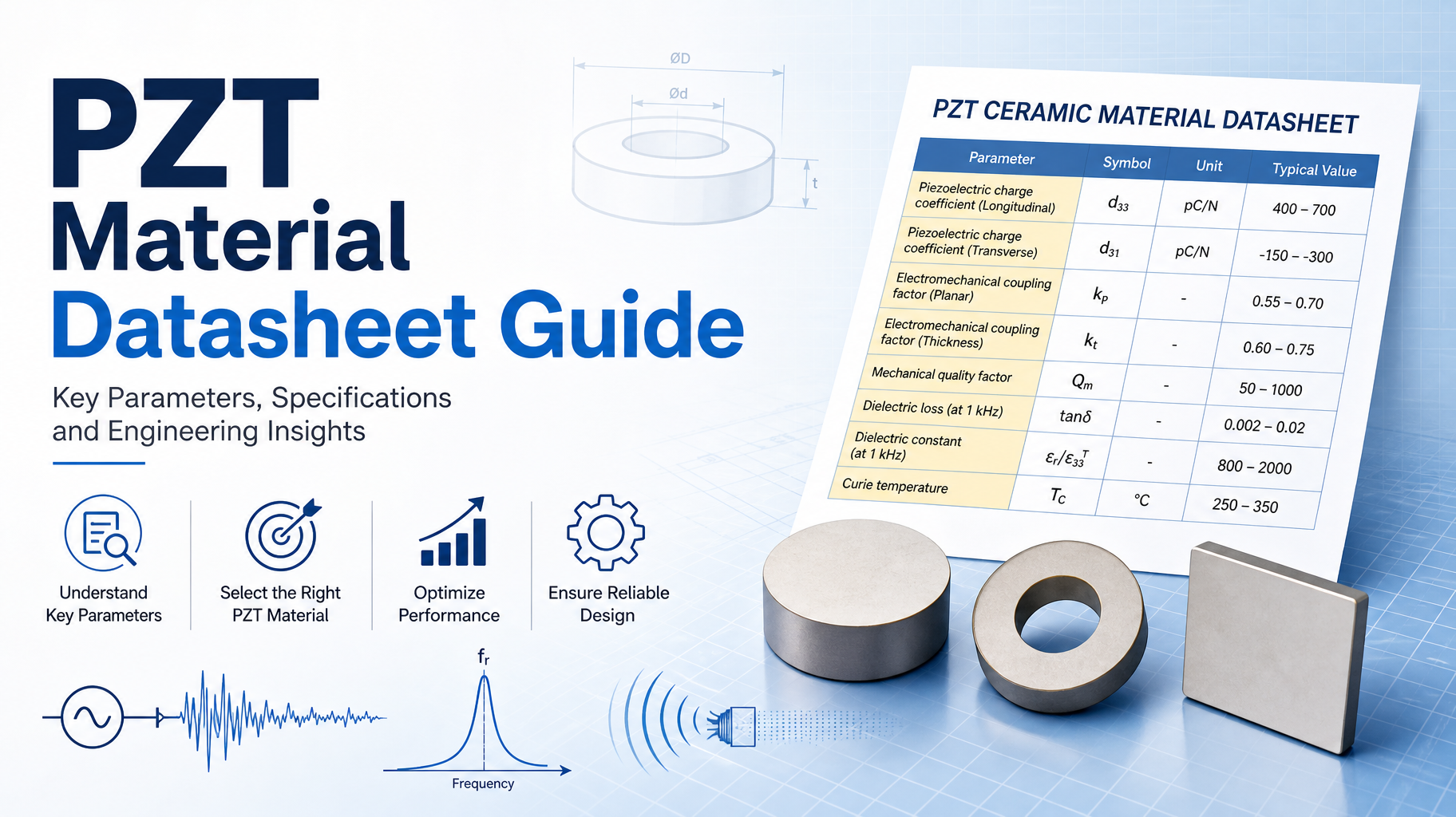
Why a PZT Material Datasheet Should Not Be Read by One Number
When selecting a PZT piezoelectric ceramic material, it is common to start with one visible number in the datasheet, such as d33, Qm, dielectric constant, or Curie temperature. This is understandable, but it is rarely enough for a reliable material decision.
A higher d33 usually indicates a stronger piezoelectric response in a specific direction, but it does not automatically mean the material is suitable for high-power ultrasonic operation. A higher Qm usually suggests lower mechanical loss and stronger resonance behavior, but it may not be the best choice for broadband sensing or receiving applications. Curie temperature also should not be treated as the long-term operating temperature of the material.
A PZT material datasheet should be read in context. Application type, vibration mode, polarization direction, driving voltage, operating temperature, duty cycle, component geometry, and assembly conditions all affect whether a material is suitable for a specific design.
If you are not yet familiar with the basic behavior of PZT ceramics, start with what PZT piezoelectric ceramic is, then return to this article to read the material parameters in context.
Start with the Application Mode Before Reading the Datasheet
The same PZT material datasheet can be interpreted differently depending on the application. Material parameters are not a universal ranking system. They are engineering indicators that help determine whether a material fits a specific device structure and operating condition.
Sensing and receiving applications
For sensors, receivers, and low-power detection devices, engineers usually pay closer attention to sensitivity, piezoelectric response, electromechanical coupling, dielectric constant, and signal stability. High power handling is usually not the first priority in these applications.
If the component is used to receive weak signals, a strong piezoelectric response and stable electrical behavior may be valuable. However, this still needs to be considered together with capacitance, noise behavior, component size, and circuit design. A high d33 value alone does not define the best material.
High-power ultrasonic applications
For ultrasonic cleaning, ultrasonic welding, power transducers, and continuous resonant operation, low loss, high Qm, controlled temperature rise, and long-term stability are often more important than simply maximizing d33.
In these applications, the PZT ceramic must withstand higher electric fields, mechanical stress, and heat generated during operation. If dielectric loss or mechanical loss is too high, the component may show excessive heating, frequency drift, reduced efficiency, or gradual performance degradation.
Precision actuator applications
For micro-positioning, precision actuation, and displacement control, engineers often look at d33, d31, capacitance, hysteresis, repeatability, and stability. A stronger piezoelectric response may help increase displacement output, but it may also increase capacitance, drive current requirements, or circuit complexity.
For actuator designs, material selection is usually a balance between displacement, response speed, thermal stability, electrical load, and long-term consistency.
d33, d31, and d15: Read the Direction of Piezoelectric Response First
The d33, d31, and d15 values commonly shown in a PZT material datasheet are piezoelectric strain constants. They describe the mechanical response generated by an electric field, or the electrical charge generated by mechanical stress. For a broader explanation of these terms, see this reference on piezoelectric constants.
What d33 means
d33 is commonly used to describe the piezoelectric response along the polarization direction. It is often one of the first numbers engineers notice because it gives a direct indication of piezoelectric conversion in a specific direction.
However, a higher d33 does not automatically make a material better. For sensitive receiving devices or low-power actuators, a higher d33 may be useful. For high-power resonant systems, Qm, dielectric loss, mechanical strength, and thermal stability may be more important.
When d31 matters
d31 is related to transverse deformation. It is often relevant in bonded patches, bending structures, thin plates, and designs where lateral strain is part of the working mechanism.
Some piezoelectric elements do not generate their useful motion mainly through thickness expansion. Instead, transverse strain may drive bending or structural movement. In these cases, reading only d33 can lead to an incorrect material judgment.
Where d15 is used
d15 is associated with shear response. It is mainly relevant in shear-mode devices or special structures. For common discs, rings, or plates, d15 may not be the primary selection parameter, but it can be important in designs based on shear motion.
When reading d coefficients, always consider polarization direction, stress direction, electric field direction, and the intended motion of the component. Different geometries emphasize different parameters. For geometry-related selection, see PZT discs, rings, plates, and tubes.
kp, kt, and k33: Not All Coupling Coefficients Mean the Same Thing
Electromechanical coupling coefficients describe how effectively a piezoelectric material converts energy between electrical and mechanical forms. Many PZT datasheets list kp, kt, k33, or other coupling values. These values are not interchangeable and should not be compared without considering the vibration mode.
What kp, kt, and k33 usually refer to
kp is commonly used as a reference for planar or radial modes, often in discs and rings. kt is commonly associated with thickness-mode vibration and is relevant in many ultrasonic designs. k33 is related to longitudinal behavior along the polarization direction.
Instead of asking whether one material has a higher “k value,” it is more accurate to identify the target vibration mode first and then look at the corresponding coupling coefficient.
Coupling coefficients must be read with geometry in mind
The same PZT material may behave differently in different component geometries. Datasheet coupling values can help with initial material screening, but they do not replace geometry design, frequency design, or prototype testing.
For example, a material that performs well in thickness mode may not be optimal in radial mode. A ceramic component that looks good in free-state testing may also shift in frequency or response after being assembled into a metal structure or transducer system.
How to Read Qm, the Mechanical Quality Factor
Qm is one of the most important values in a PZT material datasheet, especially for high-power and resonant applications. It is commonly used to describe mechanical loss and resonance behavior.
What a high Qm usually indicates
In general, a higher Qm indicates lower mechanical loss under resonant operation. This is often useful in continuous resonant and high-power applications, such as ultrasonic cleaning, ultrasonic welding, and power transducers.
This is one of the reasons why hard PZT materials are commonly used in high-power ultrasonic systems. For a broader comparison of material types, see how to choose soft and hard PZT.
Why Qm is not always “the higher, the better”
A high Qm does not make a material suitable for every application. For broadband receiving, sensing, or some low-power actuator designs, a very high Qm may not be the main objective. These applications may place more value on bandwidth, sensitivity, response speed, or circuit compatibility.
Qm should be evaluated together with power level, bandwidth, frequency stability, dielectric loss, and thermal management. Comparing Qm alone can lead to an incomplete selection decision.
Dielectric Constant and Capacitance: How Material Parameters Affect the Drive Circuit
Dielectric constant is another common value in PZT material datasheets. It affects the capacitance of a piezoelectric ceramic component with the same dimensions, and this can influence the driving circuit and system matching.
How dielectric constant affects capacitance
For the same geometry and size, a PZT material with a higher dielectric constant usually produces a higher capacitance. Capacitance affects drive current, impedance matching, amplifier loading, and circuit response.
In low-voltage actuation or high-sensitivity applications, a higher dielectric constant may be useful. In high-frequency or high-power systems, however, higher capacitance may increase the burden on the driver and must be evaluated together with the electronics.
Why a higher dielectric constant is not always better
Dielectric constant should not be used as a standalone indicator of material quality. A higher value may increase capacitance and change the electrical load of the system. In some high-power or high-frequency applications, low loss, thermal stability, and mechanical quality factor may be more important.
When reading a datasheet, dielectric constant should be considered together with capacitance, component dimensions, driving voltage, operating frequency, and circuit design.
Dielectric Loss tanδ: A Critical Parameter for High-Power Operation
Dielectric loss, often written as tanδ, describes energy loss in the material under an electric field. In low-power applications, it may not be the most visible limitation. Under high frequency, high voltage, or continuous drive conditions, it can directly affect heat generation and long-term stability.
Why dielectric loss causes heating
When a PZT element operates under an alternating electric field, part of the electrical energy is lost as heat. A higher dielectric loss usually increases the risk of temperature rise during continuous operation. Heating can cause parameter shifts, resonance frequency drift, lower efficiency, and in severe cases, reduced polarization stability.
For ultrasonic cleaning, ultrasonic welding, and power transducers, dielectric loss is therefore a critical material parameter.
Why high-power ultrasound should not be selected by d33 alone
A high d33 can provide stronger piezoelectric response, but high-power ultrasonic systems require stable operation under continuous drive, mechanical stress, and thermal load. If the material loss is too high, strong initial response may still lead to heating, efficiency loss, or reliability problems during long-term operation.
In these applications, Qm, dielectric loss, mechanical strength, thermal stability, and assembly structure should be considered together instead of relying on a single high-response parameter.
Curie Temperature Is Not the Same as Operating Temperature
Curie temperature, or Tc, is a common temperature value shown in PZT material datasheets. It is related to phase transition and the loss of piezoelectric behavior, but it should not be treated as the recommended long-term operating temperature.
Curie temperature is a material limit, not a working temperature
When a PZT material approaches or exceeds its Curie temperature, its piezoelectric properties can be severely affected. In practical engineering, long-term operating temperature should be significantly lower than the Curie temperature, with an appropriate safety margin.
If Curie temperature is used as the only reference for thermal capability, the design may overlook self-heating, local temperature rise, enclosure conditions, and drive-related thermal stress.
Actual operating temperature also depends on self-heating and assembly
The actual temperature of a PZT component is not determined only by ambient temperature. It is also affected by driving voltage, operating frequency, dielectric loss, mechanical loss, duty cycle, adhesive layers, metal parts, housing design, and heat dissipation.
For high-power or continuous operation, the ceramic body temperature may rise even when the surrounding environment is not hot. Material selection should therefore consider both thermal margin and heat management.
How to Compare Two PZT Material Datasheets
PZT datasheets from different suppliers may use different test conditions, sample dimensions, test frequencies, and material naming systems. Even if two materials have similar names, their actual behavior may not be identical. To understand how real datasheets present material values, you can refer to this public piezo ceramic material datasheet example.
Check whether the test conditions are comparable
Before comparing two datasheets, check whether the test conditions are comparable. d33, Qm, dielectric constant, dielectric loss, frequency, and aging behavior can be affected by test method, sample size, polarization condition, test temperature, and aging time.
If you compare only one number from each table without reviewing test conditions and application mode, the result may be misleading.
Recommended comparison method
| Parameter | Not recommended | Recommended approach |
|---|---|---|
| d33 | Choosing the highest value only | Evaluate with application mode, stability, and loss |
| Qm | Assuming higher is always better | Evaluate with power level, bandwidth, and resonance requirements |
| Dielectric constant | Comparing the number alone | Evaluate with capacitance and drive circuit requirements |
| Dielectric loss | Ignoring small differences | Pay close attention in high-power applications with heating risk |
| Curie temperature | Treating it as operating temperature | Maintain a sufficient thermal safety margin |
| Material grade | Relying only on names such as PZT-4 or PZT-5A | Compare the full datasheet and test conditions |
What to Provide When Requesting a Replacement or Material Recommendation
If you need to replace an existing PZT material or ask a supplier to recommend a suitable material, complete technical information is more useful than a material name alone.
If you already have a PZT material datasheet
Provide the full datasheet, target material grade, application, component shape, dimensions, polarization direction, electrode requirements, operating frequency, driving voltage, operating temperature, duty cycle, and whether the goal is to replace a material from another supplier.
This information helps the supplier determine whether the material should be closer to soft PZT, hard PZT, or a custom modified PZT formulation.
If you do not have a material datasheet
If no datasheet is available, provide the application target, drawings, sample photos, target frequency, assembly structure, driving voltage, temperature environment, and performance requirements. A supplier can use this information to estimate the material direction and structural feasibility.
You can also review the PZT piezoelectric ceramic products category to see common discs, rings, plates, tubes, and custom piezoelectric ceramic components before confirming the final material and structure.
Conclusion: A PZT Material Datasheet Is a Selection Tool, Not the Final Answer
A PZT material datasheet helps engineers understand the general direction of a material, but it should not be used as the only basis for final selection. d33, d31, kp, kt, Qm, dielectric constant, dielectric loss, and Curie temperature must be interpreted together with application type, vibration mode, structure, drive conditions, and operating environment.
A more reliable selection process is to define the application first, identify the structure and vibration mode, read the relevant parameters, and then validate frequency, output, temperature rise, and long-term stability through sample testing.
If you have a PZT material datasheet, a target material grade, or a specific application condition, you can send it to Hurricane PZT. We can help evaluate whether the material is suitable for the application and whether soft PZT, hard PZT, or a custom modified PZT material is more appropriate.