Why Engineers Often Compare PZT-4, PZT-5A, and PZT-5H
PZT-4, PZT-5A, and PZT-5H are common reference grades in engineering drawings, bills of materials, supplier datasheets, and material replacement requests. Customers often ask whether PZT-4 can be used for a high-power transducer, whether PZT-5A can be replaced by another material, or whether PZT-5H is better for a high-sensitivity device.
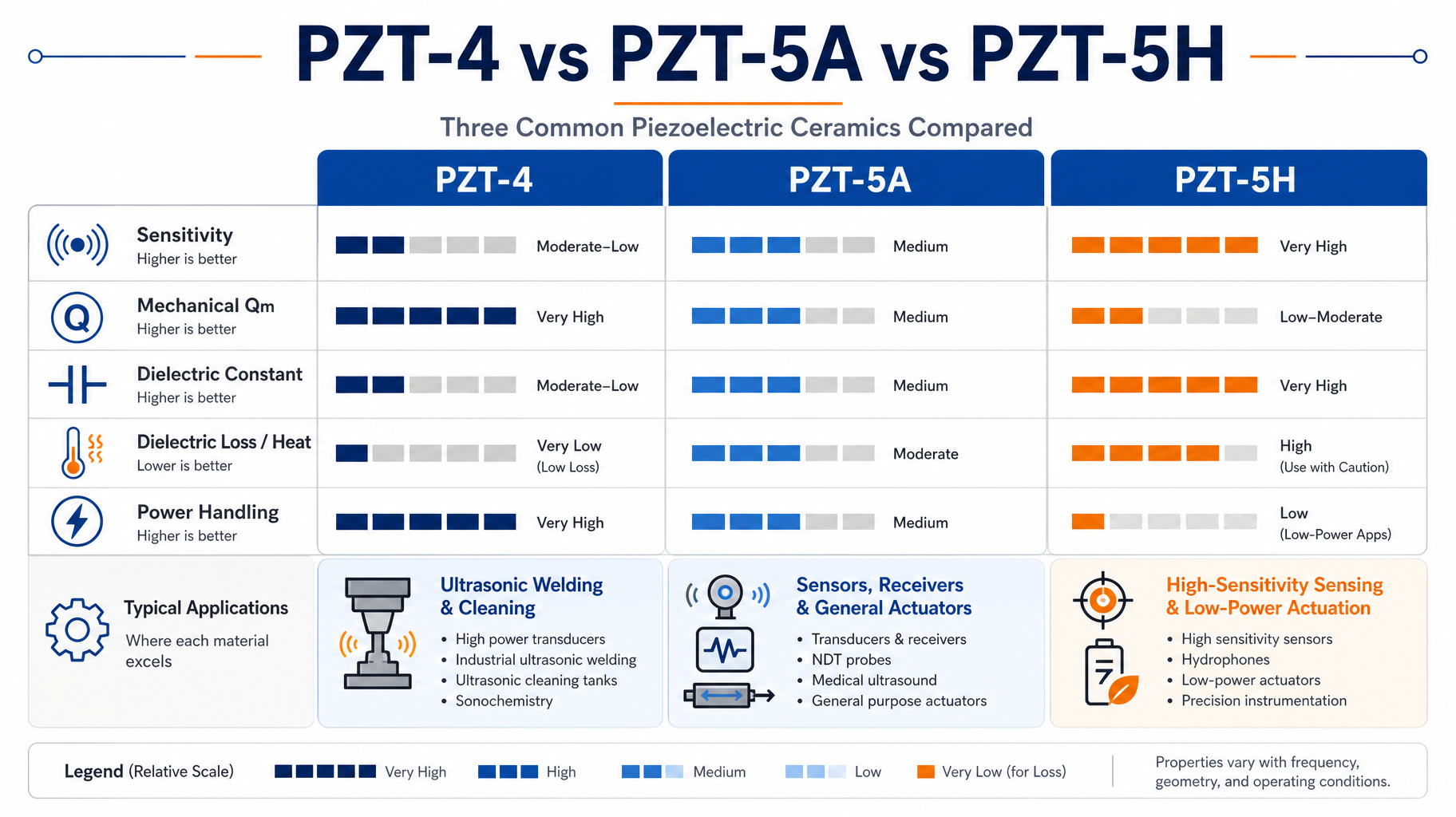
The real question is not which grade is “better.” The more useful question is whether the material direction matches the application. PZT-4, PZT-5A, and PZT-5H usually represent three different material tendencies: high-power and low-loss performance, balanced soft PZT behavior, and high-sensitivity response with higher dielectric constant.
These grades are not a quality ranking
PZT-4, PZT-5A, and PZT-5H should not be read as a simple ranking from lower to higher performance. They are better understood as different material categories for different engineering requirements.
In general, PZT-4 is often associated with hard PZT materials and is commonly used in high-power, low-loss, resonant applications. PZT-5A and PZT-5H are usually associated with soft PZT materials and are more common in sensing, receiving, low-power actuation, and high-sensitivity applications. For a broader explanation of the material types, see how to choose soft and hard PZT.
The same grade name may vary between suppliers
It is also important to note that names such as PZT-4, PZT-5A, and PZT-5H are often used to describe a material direction, but materials with the same name from different suppliers may not be fully equivalent. Formulation, dopants, sintering conditions, polarization process, test methods, and quality control can all affect the final properties.
For material substitution or a new design, the grade name should be treated as a starting point for discussion. It should not replace a complete material datasheet or sample-level validation.
PZT-4: Commonly Used for High-Power and Low-Loss Applications
PZT-4 is generally considered a hard PZT material. Its main value is usually not the highest sensitivity, but higher mechanical quality factor, lower loss, better power handling, and more stable resonance behavior.
Typical material direction of PZT-4
In high-power ultrasonic systems, the material must tolerate electric field, mechanical stress, and heat during operation. If material loss is too high, the component may heat up, drift in frequency, lose efficiency, or show reduced long-term stability. Hard PZT materials such as PZT-4 are often better suited for these conditions.
When selecting PZT-4, the focus is usually not maximum d33. The more important question is whether the material can maintain stable performance under continuous resonance, high output power, and low-loss operation.
Typical applications of PZT-4
PZT-4 is commonly used in ultrasonic cleaning transducers, ultrasonic welding transducers, bolt-clamped transducers, power ultrasonic transducers, and other designs that require low loss and stable resonant output.
These applications usually require good power handling, controlled heat generation, and stable mechanical behavior. For high-frequency continuous operation or systems with significant assembly stress, the geometry and thermal design should also be evaluated.
What to consider when choosing PZT-4
PZT-4 is not the default choice for every PZT application. If the design mainly requires high receiving sensitivity, large displacement at low voltage, or broader bandwidth, PZT-4 may not be the first candidate. In these cases, PZT-5A, PZT-5H, or another soft PZT material may be more suitable.
PZT-4 should be considered primarily as a candidate for high-power, low-loss, resonant applications, rather than as a universal material for all piezoelectric components.
PZT-5A: A Balanced Soft PZT Material
PZT-5A is generally considered a soft PZT material. Compared with PZT-4, it usually provides stronger piezoelectric response and higher sensitivity, while maintaining a relatively balanced profile in stability, dielectric constant, loss, and application range.
Typical material direction of PZT-5A
PZT-5A is often treated as a general-purpose soft PZT reference material. It is commonly used when the application requires good sensitivity, stable electrical behavior, and broad usability across sensing and actuation designs.
Compared with PZT-5H, PZT-5A usually does not aim for the highest d33 or the highest dielectric constant. Instead, it is often selected for its balance between response, loss, stability, and practical versatility.
Typical applications of PZT-5A
PZT-5A is commonly used in sensors, receivers, general actuators, low- to medium-power transducers, and some inspection, measurement, or medical ultrasound-related designs.
In these applications, the material usually needs good signal response and stable electrical behavior, but it may not need to withstand the same continuous high-power conditions required in ultrasonic welding or ultrasonic cleaning systems.
What to consider when choosing PZT-5A
PZT-5A has a wide application range, but it should not be assumed to fit every operating condition. If the application involves continuous high-power drive, significant mechanical stress, noticeable temperature rise, or strict lifetime requirements, Qm, dielectric loss, thermal stability, and assembly structure should be reviewed carefully.
For replacement projects, the name “PZT-5A” alone is not enough. The complete material datasheet and sample testing should be used to confirm frequency, impedance, output, and temperature behavior.
PZT-5H: High Sensitivity and High Dielectric Constant
PZT-5H is also generally considered a soft PZT material, but it tends to emphasize higher piezoelectric response and higher dielectric constant compared with PZT-5A. It is often considered when a design requires high sensitivity, stronger electrical response, or low-power actuation.
Typical material direction of PZT-5H
PZT-5H usually offers higher d33 and higher dielectric constant. This can be useful in certain sensing, receiving, and low-power actuator applications where a strong electromechanical response is required.
These advantages also introduce design trade-offs. A higher dielectric constant usually means higher capacitance, which can affect drive current, impedance matching, and circuit loading.
Typical applications of PZT-5H
PZT-5H is commonly used in high-sensitivity sensing, low-power actuation, receiving transducers, precision displacement devices, and some detection systems that require strong electrical response.
In these applications, sensitivity and response may be important. However, if the design involves high-power continuous operation, significant heating, or mechanical load, dielectric loss and long-term stability should be evaluated carefully.
Why PZT-5H is not simply “better” than PZT-5A
PZT-5H should not be understood as an upgraded version of PZT-5A. It may offer higher sensitivity or higher d33, but it may not be better in loss, thermal stability, capacitance loading, or high-power capability.
If the drive electronics have limited current capability, or if the application requires long-term stability, controlled temperature rise, and frequency consistency, the higher dielectric constant and larger capacitance of PZT-5H may create additional design challenges.
PZT-4, PZT-5A, and PZT-5H Material Comparison
The following table can be used as an initial screening reference. It describes common material directions, not absolute rankings across all suppliers. Actual selection should still be based on a complete datasheet, test conditions, and sample validation.
For an external reference, the PZT material properties page provides examples of how piezoelectric, electrical, and mechanical parameters differ across PZT material types.
| Material grade | Common type | Main advantages | Main limitations | Typical applications |
|---|---|---|---|---|
| PZT-4 | Hard PZT | High Qm, low loss, good power handling | Usually lower sensitivity than soft PZT | Ultrasonic cleaning, ultrasonic welding, power transducers |
| PZT-5A | Soft PZT | Balanced performance, good sensitivity, broad usability | Continuous high-power drive requires caution | Sensors, receivers, general actuators |
| PZT-5H | Soft PZT | High d33, high dielectric constant, high sensitivity | Higher capacitance; loss and stability should be evaluated | High-sensitivity sensing, low-power actuation |
Which parameters should be compared
When comparing PZT-4, PZT-5A, and PZT-5H, the material name alone is not enough. It is more useful to review the full datasheet, including d33, d31, kp, kt, k33, Qm, dielectric constant, dielectric loss, Curie temperature, capacitance, frequency stability, aging behavior, and batch consistency.
For PZT-5A and PZT-5H specifically, this public PZT-5A and PZT-5H material properties example shows how two soft PZT materials can still have different property directions.
Do Not Select PZT Materials by Grade Name Alone
PZT-4, PZT-5A, and PZT-5H are useful for communicating material direction, but they are not complete technical specifications. A grade name is a starting point, not a final selection decision.
Materials with the same name may not be directly interchangeable
Materials with the same PZT grade name from different suppliers may differ in formulation, processing, and testing conditions. Even when two materials are both called PZT-4 or PZT-5A, their actual d33, Qm, dielectric constant, dielectric loss, frequency consistency, and thermal stability may not be the same.
If the material is used in a transducer, sensor, or precision actuator, direct replacement can change frequency, impedance, output, temperature rise, or lifetime. Replacement decisions should therefore be based on the full material datasheet, not only the grade name.
The datasheet matters more than the material name
A material name helps start the discussion, but actual suitability depends on the complete datasheet, component structure, and test results. For guidance on reading d33, Qm, dielectric loss, coupling coefficients, and Curie temperature, see how to read a PZT material datasheet.
When replacing a material, it is also important to confirm test conditions, sample dimensions, polarization direction, frequency, operating temperature, and actual application conditions. A replacement is more reliable only when both material properties and device structure are aligned.
How to Choose Between PZT-4, PZT-5A, and PZT-5H by Application
Material selection should start from the application, not from the grade name. Different applications prioritize power handling, sensitivity, bandwidth, loss, temperature behavior, and structural stability differently.
High-power ultrasonic applications
Ultrasonic cleaning, ultrasonic welding, and power transducers usually prioritize Qm, low dielectric loss, low heat generation, mechanical strength, and resonance stability. PZT-4 or other hard PZT materials are often the first candidates to evaluate.
Sensing and receiving applications
Sensing, receiving, and low-power signal detection usually prioritize sensitivity, signal response, dielectric behavior, and stability. PZT-5A or PZT-5H is more commonly considered for these applications.
Precision actuation and displacement applications
Precision actuators require a balance of d33, d31, displacement output, capacitance, hysteresis, driving voltage, and thermal stability. PZT-5A, PZT-5H, or a custom modified PZT material may all be candidates depending on the drive method and mechanical design.
Atomization, medical ultrasound, and special applications
Atomizers, medical ultrasound devices, and specialized detection systems should not be assigned automatically to PZT-4 or PZT-5H. Frequency, thickness mode, bandwidth, temperature rise, component size, driving conditions, and application-specific requirements all need to be considered.
| Application | Key priorities | Possible material direction |
|---|---|---|
| Ultrasonic cleaning | Qm, low loss, low heat generation | PZT-4 or hard PZT |
| Ultrasonic welding | High power, mechanical strength, stability | PZT-4 or hard PZT |
| Ultrasonic receiving | Sensitivity, signal response | PZT-5A / PZT-5H |
| Precision actuation | Displacement, response, hysteresis | PZT-5A / PZT-5H or modified PZT |
| Medical ultrasound | Sensitivity, bandwidth, stability | Soft PZT or specialized material, depending on design |
| Atomizers | Frequency, loss, stability | Depends on structure and drive conditions |
What to Confirm When Replacing PZT-4, PZT-5A, or PZT-5H
If the goal is to replace an existing PZT-4, PZT-5A, or PZT-5H material, provide as much technical information as possible. A material name alone is usually not enough to determine whether a replacement is safe or practical.
If you already have a material grade
Provide the existing material grade, complete material datasheet, supplier name or reference source, whether the material is already in mass production, any current performance issues, and whether the replacement must be identical or only performance-equivalent.
If test reports are available, include frequency, impedance, capacitance, output, temperature rise, and lifetime data. These details help assess replacement risk more accurately.
If you have a component or drawing
Provide the shape, dimensions, tolerances, polarization direction, electrode design, target frequency, capacitance, assembly method, driving voltage, operating temperature, duty cycle, and target performance.
You can also review the PZT piezoelectric ceramic products category to see common PZT discs, rings, plates, tubes, and custom piezoelectric ceramic components before preparing replacement information.
Why sample testing is still necessary
Material replacement cannot be confirmed by grade name and datasheet alone. Frequency, impedance, output, temperature rise, bandwidth, and lifetime in the final device can all be affected by geometry, polarization, electrodes, assembly, and test conditions.
Before formal replacement, sample testing is usually needed to verify whether the material meets the target application requirements. This is especially important for high-power systems, medical applications, long-term continuous operation, or projects with strict batch consistency requirements.
Common Misunderstandings About PZT-4, PZT-5A, and PZT-5H
Misunderstanding 1: PZT-5H is always better than PZT-5A
PZT-5H may offer higher sensitivity or higher d33, but it may not be better in stability, loss, capacitance loading, or high-power capability. Suitability depends on the application, not on whether the grade name appears to be “higher.”
Misunderstanding 2: PZT-4 is only useful for high-power systems
PZT-4 is commonly used in high-power applications, but its low loss and stability may also be useful in other resonant or stability-focused designs. However, if the application requires high sensitivity or large displacement, it should still be evaluated carefully.
Misunderstanding 3: PZT-4 from different suppliers can be swapped directly
Materials with the same name may differ in formulation, processing, and test conditions. Direct replacement can change frequency, impedance, temperature rise, or output. A complete datasheet comparison and sample test are recommended before substitution.
Misunderstanding 4: Similar d33 means the material can be replaced
d33 describes piezoelectric response in one direction. It does not represent Qm, dielectric loss, dielectric constant, temperature stability, or mechanical behavior. For high-power or high-stability applications, replacement based only on d33 is risky.
Misunderstanding 5: The same material grade means the same frequency and performance
Final frequency and device performance are also affected by dimensions, geometry, polarization direction, electrode design, assembly method, and test conditions. The same material grade does not guarantee the same assembled frequency, impedance, or output.
Conclusion: Screen by Application First, Then Verify with Full Datasheet and Testing
The difference between PZT-4, PZT-5A, and PZT-5H is not a simple performance ranking. PZT-4 is generally used for high-power, low-loss, resonant applications. PZT-5A is commonly used as a balanced soft PZT material. PZT-5H is often selected for high-sensitivity and low-power response applications.
Final material selection should still be based on the complete datasheet, component structure, driving conditions, operating temperature, and sample test results. For replacement projects, it is also important to confirm the existing material source, test conditions, geometry, and target performance before making a decision.
If you are not sure whether to choose PZT-4, PZT-5A, PZT-5H, or a custom modified PZT material, you can send the application conditions, target parameters, or existing material datasheet to Hurricane PZT. We can help evaluate the appropriate material direction for your application.